


How to Improve Lead Quality from B2B Ads

Stop wasting ad spend on poor-fit leads. Learn how to improve lead quality from B2B ads and connect campaign performance to revenue.
June 24, 2026
B2B Advertising


%20-%20new%20v2.png)
Silvio Perez
Founder @AdConversion
Improving lead quality from B2B ads means making sure the buyers you attract are the ones your sales team actually wants to talk to.
Sounds simple enough, but it’s a challenge many B2B companies face. Leads keep coming in, but very few turn into real opportunities and revenue.
The result is wasted ad spend, frustrated sales reps, and disappointing conversion rates.
Learn how to spot a prospect that’s genuinely worth pursuing, what it takes to attract more of them, and how to tell if your paid advertising is paying off.
What Defines a High-Quality Lead from B2B Ads?
A high-quality lead from B2B ads is a potential client who fits your ideal buyer persona, has a real reason to explore your solutions, and can influence the purchase decision.
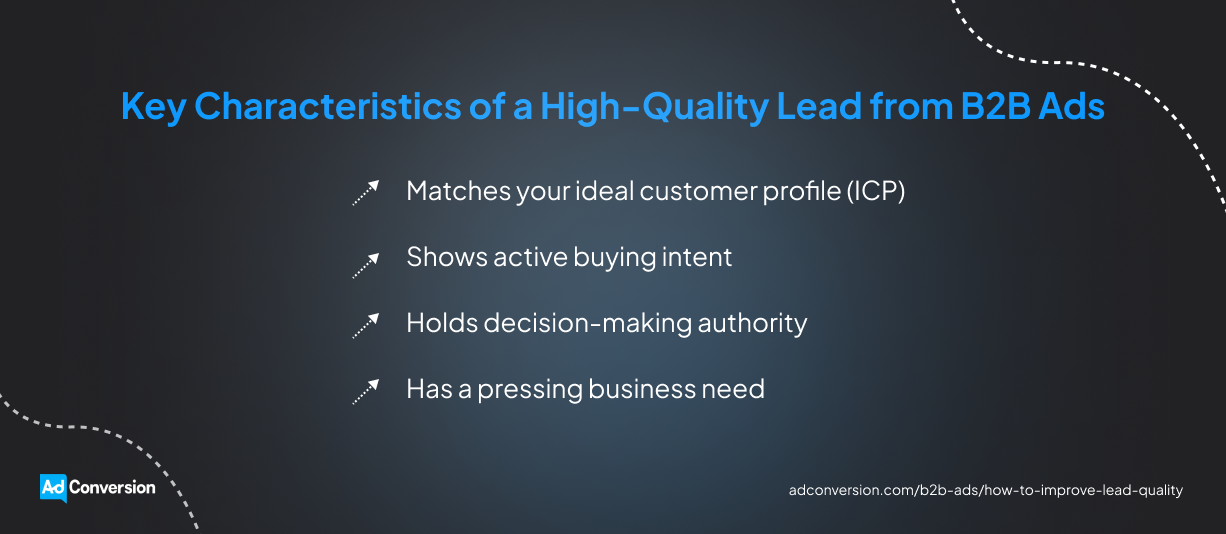
Matches your ideal customer profile (ICP)
Your best customers tend to have a lot in common. They usually operate in the same industry, are of similar company size, and face the same challenges.
That's why one of the first signs of a quality lead is how closely it matches your ICP. The closer the fit, the greater the chance that the prospect becomes a sales opportunity.
Shows active buying intent
There's a big difference between someone who's just curious and someone who's actually evaluating solutions.
High-intent buyers take action. They search for pricing, compare vendors, request demos, read multiple case studies, or revisit your website several times after seeing your ads.
These signals suggest the prospect is actively researching options and getting closer to a purchase decision.
Holds decision-making authority
A prospect can show real interest in your product, but if they don’t have any power over the buying decision, the deal might not go through.
The most valuable leads include decision-makers or stakeholders directly involved in vendor selection. Department heads, budget owners, and operational leaders can all move deals forward.
Has a pressing business need
If a prospect isn’t dealing with a pressing issue, it can take months for them to reach out.
Qualified leads usually have a reason to act now. Maybe they're trying to hit an aggressive growth target, replace an underperforming tool, or solve a costly operational issue.
This urgency creates momentum and shortens B2B sales cycles.
Why Does Lead Quality Matter More Than Lead Volume in B2B Advertising?
Lead quality matters more than lead volume in B2B advertising because it actually turns your ad spend into business growth.
Generates more revenue
Your pay-per-click (PPC) return on investment (ROI) increases once you start attracting prospects who are likely to buy, not just submit a form.
High-quality leads already fit your offering and have a real business need, so they’re more likely to become customers, close deals at higher rates, and contribute to your annual recurring revenue (ARR).
Creates more sales opportunities
When your ads attract the right audience, sales reps spend less time sorting through poor-fit accounts and more time advancing qualified prospects.
As a result, a larger percentage of leads move from initial contact to discovery calls, demos, and sales opportunities.
Reduces wasted time and budget
Low-quality leads make paid advertising more expensive than it needs to be.
You're paying for every click and conversion, even if the prospect is a bad match.
On top of that, your sales team still has to review, follow up, and qualify those leads.
If the prospect turns out to be a poor fit, all that time and budget go to waste.
Improves revenue attribution
You can't accurately measure advertising performance if most of your leads never become opportunities or customers.
For example, a LinkedIn Ads campaign that generates 200 leads might look successful at first. But if only a handful of those prospects sign a contract, the numbers don't tell the full story.
High-value leads make it easier to tie ad spend to revenue. You can quickly spot which paid channels, campaigns, audiences, and offers actually contribute to business growth.
Despite all these benefits, 37.7% of B2B marketers are still pressured to deliver marketing-qualified leads (MQLs) regardless of quality, based on Marketing Week’s ‘State of B2B Marketing’ survey.
How Do You Improve Lead Quality from B2B Ads?
You can improve lead quality from B2B ads by making sure your campaigns attract, qualify, and convert the right buyers.
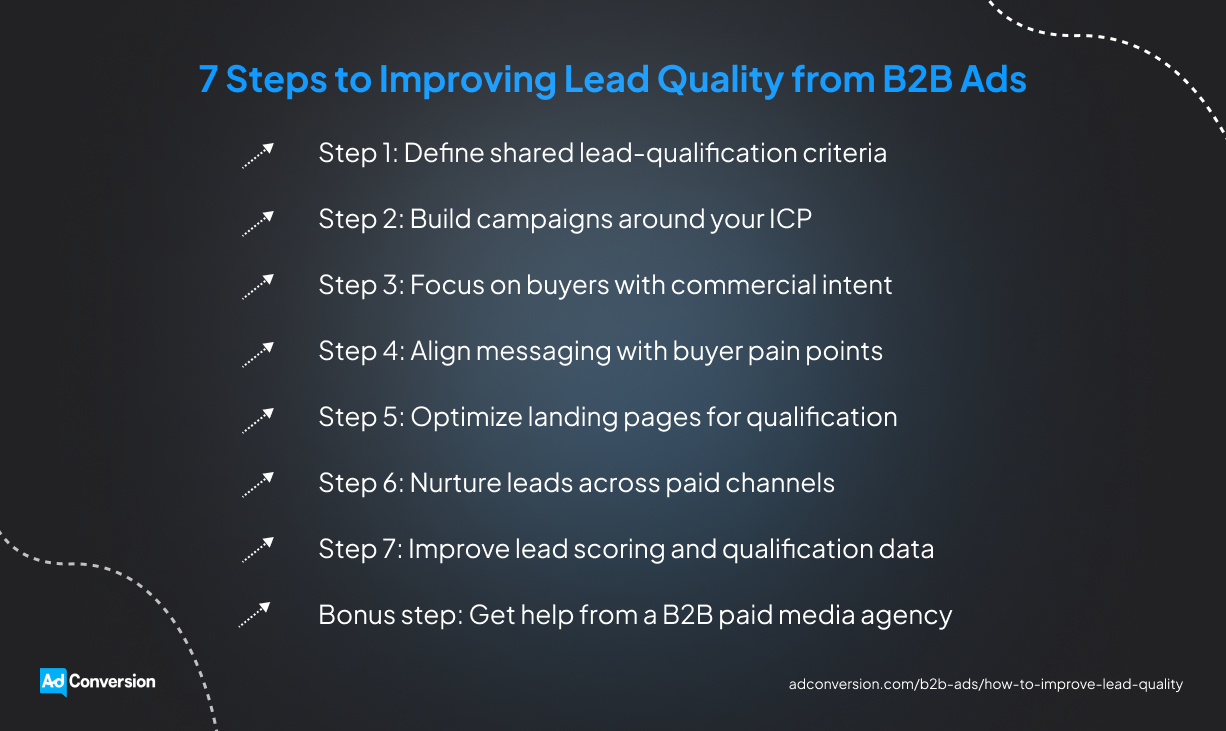
Step 1: Define shared lead-qualification criteria
Lead quality improves when marketing and sales evaluate prospects using the same criteria.
Analyze successful deals together and find common qualification factors. Pay close attention to the job titles of the people you’re targeting, their business needs, and their buying intent.
Once you’re all on the same page, you can use those criteria to guide audience targeting, lead scoring, and follow-ups.
Step 2: Build campaigns around your ICP
Be more specific about who you're trying to reach.
Review your customer base to identify which accounts generate the most revenue, have the highest retention rates, and progress fastest through the sales funnel.
Look for shared characteristics like industry, company size, geography, budget, use case, and buying trigger.
Use those patterns to build audience segments across Google, LinkedIn, and other paid channels.
The closer your targeting matches your ICP, the more likely you are to attract qualified prospects.
Step 3: Focus on buyers with commercial intent
Build your paid media campaigns around audiences that already show signs of buying intent.
The exact targeting options vary by ad platform, but you can usually improve lead quality by focusing on firmographic and intent data.
- Firmographic filters are the corporate equivalent of personal demographics. They include company size, annual revenue, industry, job title, and seniority level, which help you reach companies and their representatives that closely match your best customers.
- Intent data shows you which decision-makers are actively researching topics, products, and services related to your solution, so you can target them. To get this info, you can analyze your website visits and content downloads, or use third-party data providers such as Bombora, G2 Buyer Intent, or TechTarget Priority Engine.
Step 4: Align messaging with buyer pain points
Your ad messaging should immediately show prospects you understand their problem and can solve it.
Gain insights from your own sales calls and customer interviews. You can also check industry forums, Reddit threads, competitor reviews, and survey responses to spot the most common challenges buyers face.
Address those pain points in your B2B ads and landing pages to attract and engage higher-quality leads.
Step 5: Optimize landing pages for qualification
Once a prospect clicks your ads, the landing page should quickly help them decide whether they're a good fit.
Clearly explain who your solution is for, how it works, and what results customers can expect.
Include details that let visitors self-qualify, such as pricing, customer examples, use cases, implementation requirements, or service limitations.
You can also add qualification fields to your forms, such as company size, job title, or monthly budget.
All these steps filter out poor-fit prospects and give your team more context before the first sales conversation.
Check out these 10 B2B SaaS landing page tips for more optimization options.
Step 6: Nurture leads across paid channels
Most B2B buyers need multiple interactions before they're ready to speak with sales.
They might click a B2B YouTube ad today, attend a webinar a month later, and eventually respond to an email campaign.
Each interaction helps prospects learn more about your product or service and gain trust in your company.
To stay top of mind throughout this long buyer journey, you need to nurture leads every step of the way.
Use a mix of prospecting and retargeting campaigns across paid channels like Google, YouTube, LinkedIn, Meta, and Reddit. This way, you’ll show up everywhere your buyers scroll.
You can also combine paid advertising with content marketing, email outreach, and other lead nurturing tactics.
Step 7: Improve lead scoring and qualification data
Lead scoring helps you rank prospects based on factors like company fit, buying intent, and engagement behavior. The higher the score, the more likely that prospect is to become a qualified opportunity.
Whitehat’s 2026 ‘B2B Lead Generation’ Report found that B2B companies achieve 39–40% MQL-to-SQL (sales-qualified lead) conversion rates using behavioral lead scoring, compared to the 13% average.
Still, your lead scoring system is only as good as the data behind it. You need firmographic, intent, lead source, and engagement history details.
Data enrichment tools, like Apollo.io and ZoomInfo, can automatically add many of these details after a form submission.
Once this data enters your customer relationship management (CRM), you can use scoring models and automation workflows to identify sales-ready leads and prioritize follow-up efforts.
Bonus step: Get help from a B2B paid media agency
If you don't have the in-house expertise, time, or resources to improve lead quality yourself, you can work with a B2B paid media agency.
These agencies build advertising programs that attract qualified buyers, reduce wasted ad spend, and produce more sales opportunities.
You just need to find a partner that understands your industry, audience, and growth goals.
AdConversion Agency lives and breathes paid media for B2B SaaS. The team digs into your ICP, messaging, CRM data, and current campaigns to find the root causes behind poor-fit leads and missed opportunities.
Using those insights, the agency rebuilds your paid advertising strategy around qualified pipeline growth.
AdConversion then takes care of every part of campaign execution, including ad creative production, targeting, bidding, and budgets.
The team runs paid media programs across Google, YouTube, Meta, LinkedIn, Reddit, and other channels to cover every stage of the buyer’s journey.
AdConversion also creates dedicated landing pages for each ad campaign to turn more clicks into sales conversations and weed out unqualified prospects.
The team continually experiments with new ad formats, keywords, offers, and messaging to improve lead quality and conversion rates.
Meanwhile, AdConversion’s proprietary AI ad automation tool, Sami, watches over your campaigns 24/7.
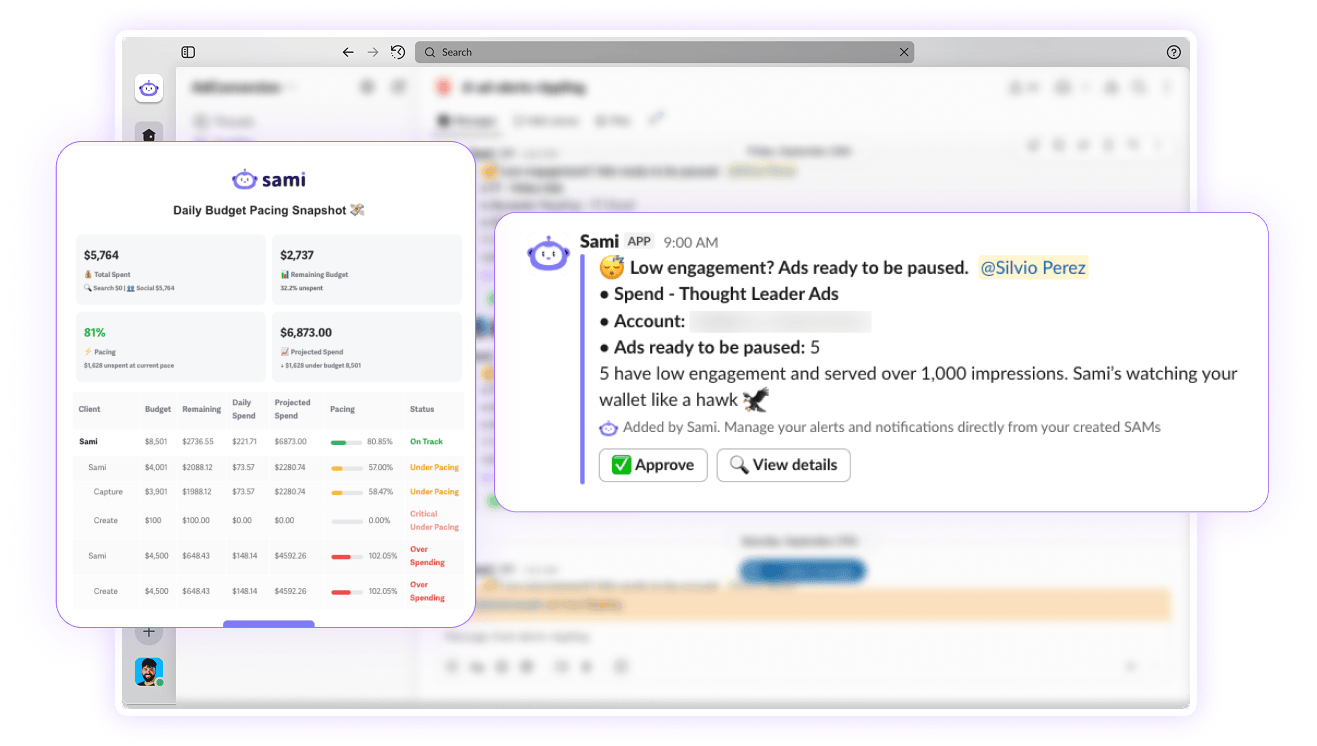
If an ad is burning budget with no meaningful conversions to show for it or shows signs of fatigue, Sami automatically pauses it.
This AI sidekick can also adjust bids and shift budget toward high-performing campaigns to keep performance up and avoid wasted spend.
How Do You Improve Lead Quality from Google Ads?
You can improve lead quality from Google Ads by attracting high-intent buyers and teaching Google what a qualified prospect looks like.
1. Focus on high-intent searches
Build your campaigns around keywords that signal buying intent.
For instance, a cloud security platform will produce better leads from searches like "cloud security software pricing," "best cloud security platform," and "cloud security demo" than from a broad "what is cloud security" search.
Look for “pricing,” “competitor,” “alternative,” “software,” “platform,” “demo,” and “vendor” queries in your Google Ads search terms report to find the best ones.
2. Filter out irrelevant traffic
Your search terms report also reveals irrelevant searches that attract poor-fit traffic.
Check for queries that include words like “free,” “jobs,” “careers,” “salary,” “certification,” “course,” “template,” and “tutorial,” which have no buying signal.
Add these terms and any variations to your negative keyword list, and update it weekly. This prevents Google from spending your budget on people who aren't potential buyers.
Check out AdConversion’s guide to using negative keyword lists in Google Ads for more insights and examples.
3. Group campaigns by search intent
Don’t put all your keywords in the same campaign. Group them by where the target audience is in the decision-making process.
A simple approach is to separate informational, consideration, and transactional searches.
- Informational keywords target buyers who are researching a problem or learning about a solution before they start evaluating vendors. For example, "what is cloud security posture management," "how to automate accounts payable," "employee onboarding best practices." Target these only if you see tangible business value.
- Consideration keywords reach prospects who understand the problem and are actively comparing different solutions. "Top cloud security platforms," "best accounts payable automation software," "employee onboarding software comparison" are just a few examples.
- Transactional keywords attract buyers who are evaluating specific vendors and nearing a purchase decision. Examples include "Wiz pricing," "Tipalti alternatives," and "Rippling demo."
This way, you can tailor your budget, bidding strategies, ad copy, offers, and landing pages to each stage of the buyer’s journey.
4. Feed qualified lead data back into Google Ads
Google can only optimize for the conversions it sees.
If you're only tracking demo requests or form submissions, the algorithm will continue to look for people likely to complete those actions.
To improve lead quality, connect your CRM to your Google Ads account and set up offline conversion tracking.
This tells Google which prospects become MQLs, SQLs, opportunities, and customers after they enter your pipeline.
The more sales data you feed back into Google Ads, the better it gets at finding the right-fit buyers.
5. Optimize bidding for conversion value
Once you've set up offline conversion tracking, you can start using value-based bidding (VBB).
This Google Smart Bidding strategy uses AI to prioritize leads most likely to generate revenue.
Start by assigning conversion values based on lead quality and potential business impact. For example, a demo request from a VP at a target account should be worth more than a form fill from a company you'd never sell to.
Send Google your conversion value data for about 6 weeks so it can learn to spot your most valuable opportunities. Then you can switch to VBB.
How Do You Improve Lead Quality from LinkedIn Ads?
You can improve lead quality from LinkedIn Ads by getting in front of the right companies and the people who influence buying decisions.
1. Target revenue-generating accounts
Start with the companies you actually want to sell to.
Upload a list of existing customers, open opportunities, and target accounts from your CRM into LinkedIn Campaign Manager.
Then create separate campaigns for each audience instead of lumping them together.
For example, a cybersecurity company could build one campaign for Fortune 1000 accounts, another for mid-market technology companies, and a third for existing pipeline accounts. This gives you more control over budgets, messaging, and performance.
You can also create lookalike audiences to help LinkedIn find companies that resemble your best customers.
These 10 tips for running account-based marketing (ABM) using LinkedIn Ads might prove useful.
2. Reach the right decision-makers
Map out the people who influence buying decisions and build custom LinkedIn audiences around the entire buying committee.
Depending on your product, you can target executives, department heads, technical evaluators, procurement teams, and end users.
For example, a revenue intelligence platform might target CROs, VPs of Sales, Revenue Operations leaders, and Sales Operations managers within the same account.
In addition to the job title, layer in targeting filters to narrow down the audience to your buyer persona.
To get the best matches and exclude poor-fit leads, combine job experience filters (title, seniority, function) with company attributes (industry, size, growth).
For instance, a customer data platform could target VP- and Director-level Marketing Operations leaders at enterprise SaaS companies that experienced an 11-20% growth in the past year.
3. Ask better questions in Lead Gen Forms
Add custom questions to your LinkedIn Lead Gen Forms to qualify prospects before they reach your sales team.
Focus on details that influence buying decisions, such as company size, existing software stack, implementation timeline, or main business challenge.
For instance, a customer support platform could ask how many support agents the company has or whether they're planning to replace an existing solution within the next 12 months.
4. Re-engage prospects who showed interest
Build separate retargeting audiences for each type of engagement.
Create one audience for website visitors, another for people who watched at least 50% of a product video, and another for Lead Gen Form openers who didn't submit.
Then match the message to the action they already took. Someone who visited your pricing page could see a demo offer, while someone who watched a product overview video might see a customer success story.
The more relevant the follow-up, the more likely buyers are to return and convert.
If you want to win back more prospects, take a look at AdConversion’s step-by-step guide to building a multichannel B2B retargeting strategy.
5. Teach LinkedIn what a qualified lead looks like
Connect LinkedIn Ads to your CRM using CRM Sync or the Conversions API and feed it qualified lead data.
You can then use Qualified Leads Optimization to help LinkedIn prioritize prospects that resemble your best opportunities.
Just like Google Ads, LinkedIn Ads becomes much more effective when it can learn from actual pipeline and revenue outcomes.
You can learn more about improving lead quality from LinkedIn Ads, Google Ads, and other paid channels by taking AdConversion’s free B2B advertising courses.
How Do You Measure Lead Quality from B2B Ads?
The best way to measure lead quality from B2B ads is to look at what happens after a prospect converts.
Track lead progression through the funnel
High-quality leads should keep moving through your sales funnel.
If 500 people click your Google ads, but only a handful qualify for a sales conversation, you're likely attracting the wrong audience.
On the other hand, if a large share continues moving to the next stage, that's a sign your paid media is paying off.
Tracking lead progression helps you pinpoint the stages where prospects lose interest so you can deal with whatever is causing the drop-off.
Measure pipeline and revenue contribution
Many prospects can look promising during the qualification process, but never contribute to business results.
To get a realistic view of advertising performance, you need to measure the pipeline and revenue generated by each campaign.
A campaign that generates fewer prospects can still outperform one that produces hundreds of conversions if it brings in bigger opportunities.
Connect campaigns to business outcomes
You can’t accurately measure lead quality if marketing and sales data live in separate systems.
Connect your ad accounts and Google Analytics to your CRM to see the full story. This setup allows you to track the entire customer journey and tie lead sources to opportunities and revenue.
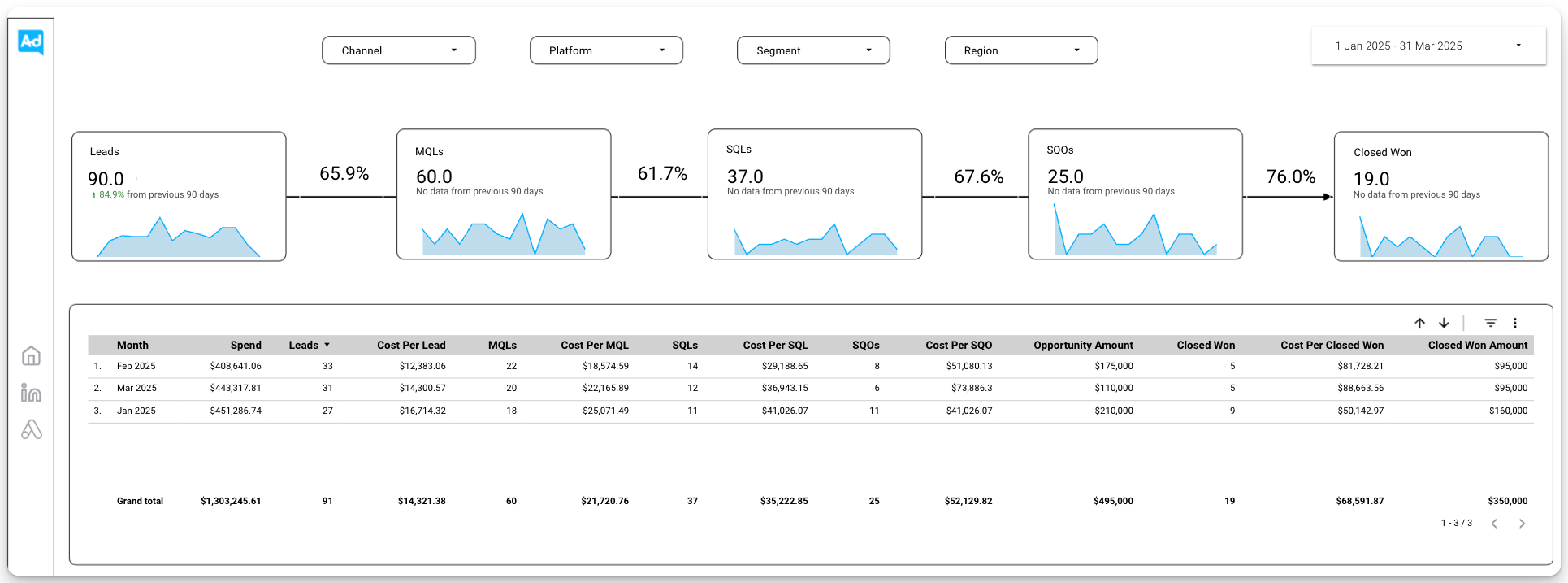
A revenue-focused dashboard centralizes all this data into a single view, so you don’t have to dig through CRM reports and spreadsheets to assess lead quality.
If you lack the time or skills to build one yourself, AdConversion’s Data Analytics Agency can set it up for you.
The agency creates custom Paid Revenue Dashboards that integrate with your CRM and ad platforms and update in real time.
You can track leads, MQLs, SQLs, opportunities, and closed-won revenue to see which paid channels contribute most to your business outcomes.
What Are the Most Common Mistakes That Reduce Lead Quality from B2B Ads?
Most lead quality issues in B2B advertising can be traced back to a handful of decisions that attract the wrong prospects or make it harder to identify the right ones:
- Trying to reach everyone usually increases lead volume, but it also attracts companies that don't fit your offering, budget, or use case. As a result, more prospects get disqualified later in the sales process.
- Using generic ad messaging makes it harder for buyers to recognize that your solution fits their needs. This attracts more clicks from curious prospects than from right-fit buyers.
- Sending every ad click to the same landing page creates a mismatch between the ad and the offer. Prospects arrive expecting one thing, find another, and either leave or convert without fully understanding whether they're a good fit.
- Optimizing campaigns based on cost per lead (CPL) alone can be misleading. Lower-cost leads might look good in platform reports but fail to become qualified opportunities or customers.
- Working with incomplete lead data makes it difficult to evaluate fit, intent, and buying readiness. This can lead to poor qualification decisions and misleading performance insights.
Final Thoughts
Improving lead quality from B2B ads doesn’t always require big changes. Sometimes, simply getting the fundamentals right will do the trick.
As you refine your targeting, improve your messaging, and connect advertising performance to real business outcomes, qualified opportunities tend to follow.
If you need help putting all the pieces together or want faster results, have a quick chat with AdConversion.

.png)
Related Articles
How to Improve Lead Quality from B2B Ads
How to Track and Measure B2B Pay-Per-Click ROI

Top 12 B2B SaaS Marketing Agencies: A Detailed List [2026]
Join 0,000 B2B marketers leveling up their paid advertising skill set! 🚀
Join 0,000 B2B marketers leveling up their paid advertising skill set! 🚀


