


How to Track and Measure B2B Pay-Per-Click ROI

Discover effective strategies to track and measure B2B pay-per-click ROI. Optimize your campaigns and maximize your advertising investments today.
B2B Advertising


%20-%20new%20v2.png)
Silvio Perez
Founder @AdConversion
Measuring B2B pay-per-click ROI means figuring out which campaigns actually bring in pipeline and revenue.
Sounds simple enough, but once long sales cycles, multiple touchpoints, and offline conversions enter the picture, things get tricky.
That’s why accurate tracking matters so much. Without the right setup, it’s almost impossible to tell which ad campaigns drive growth and which ones quietly waste your budget.
That confusion ends here. Find out how to track ROI properly, connect paid advertising performance to business outcomes, and build reporting systems that executives will actually trust.
What Is ROI in B2B Pay-Per-Click Advertising?
ROI in B2B pay-per-click (PPC) advertising measures how much pipeline, revenue, or profit your paid search and paid social campaigns produce. Based on the results, you can decide if the business outcomes justify the marketing investment behind them.
The main difference between B2B and B2C PPC ROI is timing. Most B2B buyers don’t just click an ad and purchase right away. They research vendors, talk internally, and go through several sales calls before signing a contract.
That’s why B2B marketing teams measure advertising ROI based on opportunities and revenue, not just quick conversions.
Why Does Measuring Pay-Per-Click ROI Matter in B2B Campaigns?
Measuring B2B PPC ROI matters because it helps you understand if your marketing spend actually contributes to revenue and business growth.
Moves attention away from vanity metrics
Clicks, impressions, and marketing-qualified leads (MQLs) can make a campaign look successful even if it brings in very few sales opportunities.
ROI tracking gives you a more honest view of B2B advertising performance.
Instead of celebrating lead volume alone, you can focus on the metrics that really matter, like sales-qualified leads, customer acquisition cost, and return on ad spend.
Improves ad budget allocation
Measuring ROI eliminates guesswork and lets you compare PPC campaigns based on real data. As a result, you can quickly spot high-performing ads that deserve more budget and weak ads you need to cut.
Based on EMARKETER’s findings, 77.3% of B2B enterprise marketers allocate campaign budgets based on past performance data.
Refines targeting and campaign strategy
Accurate ROI tracking shows you which ad campaigns attract high-intent buyers.
You can then compare audiences, ad creatives, offers, and landing pages to understand what turns interest into sales calls.
Based on this data, you can refine targeting and messaging to build a more lucrative paid media program.
Justifies ad spend to leadership
Executives and finance departments always put pressure on marketing teams to justify spending.
This makes perfect sense given that paid media takes up 30.6% of marketing budgets and 2.4% of company revenue, according to a 2025 Gartner survey.
ROI reporting connects ad spend to opportunities, closed deals, and total revenue, which makes those conversations much easier.
Once leadership sees measurable results, they’ll get off your back and might even invest more in PPC advertising.
Why Is B2B Pay-Per-Click ROI So Difficult to Measure?
B2B PPC ROI is hard to measure because buyers engage with multiple campaigns, channels, and stakeholders before becoming customers.
Long sales cycles break attribution
B2B buyers rarely convert after a single click. They might interact with your Google ads, blog posts, marketing emails, and sales teams for months before signing a contract.
By the time revenue shows up in your customer relationship management (CRM) system, most attribution models have already lost track of the earlier touchpoints.
Buying committees complicate tracking
Most B2B purchases involve multiple decision-makers, such as finance teams, department heads, and executives.
The person who actually clicks your B2B ad is usually not the same as the one attending the demo call or signing the contract. That makes it much harder to track how PPC influences customer acquisition.
Last-click attribution misses the full journey
Many analytics tools still use last-click attribution models. Meaning the final touchpoint before conversion receives all the credit, while earlier campaigns are completely ignored.
For instance, a LinkedIn thought leader ad might look like the hero, even if paid search and content marketing built initial brand awareness and interest.
The 2025 Buyer Experience Report shows that 80% of B2B contracts are won by the vendor the buyer picked as their favorite during the research phase, before even making contact.
Disconnected data creates blind spots
Most B2B companies track data using separate platforms that don’t communicate with each other. Your CRM stores sales data, Google Analytics tracks website traffic, and each ad platform reports on its own campaign metrics.
Without proper integration, it’s next to impossible to connect ad spend to pipeline and revenue.
What Metrics Actually Matter for B2B PPC Advertising?
The metrics that matter most in B2B PPC advertising are the ones that show how campaigns contribute to pipeline, customer acquisition, and revenue.
Pipeline metrics
Pipeline metrics show whether your paid campaigns create high-quality sales opportunities that can turn into revenue:
- Sales qualified leads (SQLs) track prospects that sales teams accepted as worth pursuing.
- Sales qualified opportunities (SQOs) measure deals that entered an active sales process with real buying intent.
- Opportunity creation rate (OCR) shows how many leads eventually become sales opportunities.
- Pipeline velocity tracks how fast opportunities move from first conversation to closed deal.
Efficiency metrics
Efficiency metrics reveal how profitably your paid ads acquire leads, opportunities, and customers:
- Cost per click (CPC) shows how much you pay each time someone clicks on your ad.
- Cost per lead (CPL) tells you the cost of winning over a new prospect.
- Cost per SQL measures the cost of getting a sales-ready lead.
- Cost per conversion measures how much it costs to generate a specific conversion action, such as a demo request, webinar registration, or whitepaper download.
- Cost per acquisition (CPA) tracks how much you spend to acquire a paying customer from a specific campaign or channel.
- Customer acquisition cost (CAC) calculates how much it costs to turn a prospect into a paying customer, factoring in all marketing and sales expenses.
- Pipe-to-spend ratio compares generated pipeline against your total paid media investment.
- Lifetime value (LTV) to CAC ratio shows whether customer revenue outweighs acquisition costs over time.
Revenue metrics
Revenue metrics uncover how much money your paid channels actually produce for the business:
- Closed-won revenue tracks the total revenue attributed to paid ad campaigns.
- Annual recurring revenue (ARR) measures the yearly subscription revenue generated from customers.
- Return on ad spend (ROAS) shows how much revenue your ads produce compared to how much you spent on the campaigns.
- Customer lifetime value (CLV) estimates how much total revenue a customer generates during your business relationship.
How Do You Calculate B2B Pay-Per-Click ROI?
You calculate B2B PPC ROI by comparing the revenue your campaigns produce against the total amount invested in them.
Define your total investment
Calculate your full advertising investment by factoring in every single marketing cost.
Besides platform ad spend, don’t forget to include ad copy and design production, landing page development, software subscriptions, internal resources, and PPC marketing agency fees.
The more complete the number, the more accurate your ROI calculation becomes.
Track your returns
Set up a detailed tracking system to find out what your paid campaigns produce in return (more on this later).
Once the setup is in place, you can measure the revenue metrics that best match your business model and sales cycle.
Some B2B companies focus on closed-won revenue, while others also measure influenced pipeline, ARR, or CLV.
Use a simple formula
Once you have both numbers, you can calculate ROI with a simple formula:
ROI = [(Revenue - Total Cost) / Total Cost] × 100
If a campaign generates $500,000 in revenue and costs $100,000 to run, the return on investment is 400%. In other words, the campaign produced four times the original investment.
How Do You Build a Pay-Per-Click ROI Tracking System?
To build a PPC ROI tracking system, you need to connect your ad campaigns to revenue data.
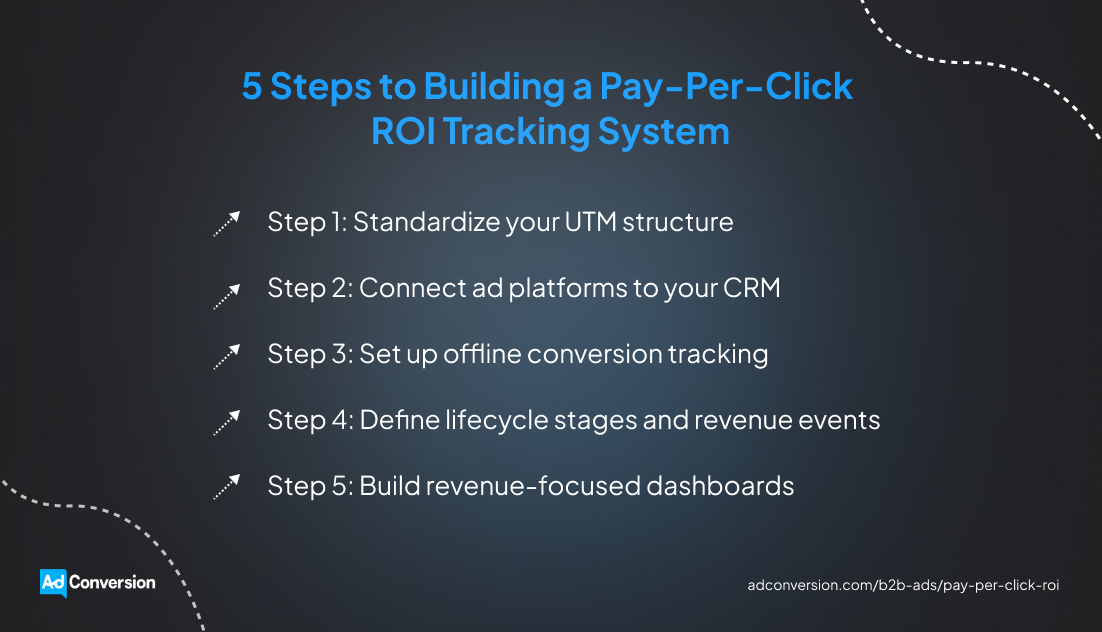
Step 1: Standardize your UTM structure
UTM (Urchin Tracking Module) parameters are small tracking labels added to URLs that tell your CRM and analytics platforms where a visitor came from.
For example, a LinkedIn campaign URL can include tags like utm_source=linkedin, utm_medium=paid-social, and utm_campaign=q4_demo_campaign.
The key is consistency. If one campaign uses linkedin_ads and another uses linkedin-paid, your reporting can quickly get messy.
Create one naming system for each channel, campaign, and ad variation, then stick to it everywhere.
You can quickly assign names and avoid inconsistencies using AdConversion’s free UTM generator.
Step 2: Connect ad platforms to your CRM
Your ad platforms and CRM should always work together. Once you link Facebook Ads, LinkedIn Ads, Google Ads, and Microsoft Ads accounts to HubSpot or Salesforce, you can follow leads from first click all the way to closed-won revenue.
This setup gives you a much better view of campaign quality because it goes beyond lead generation. Instead of just clicks and impressions, you see which marketing efforts create real sales opportunities and profit.
Step 3: Set up offline conversion tracking
Offline conversions are actions that happen after someone clicks your PPC ad. For instance, a buyer can book a demo, chat with sales, and eventually sign a contract.
Offline conversion tracking sends all that behind-the-scenes revenue data back to your ad platforms, which tie it to the original ad click. Based on this info, paid media algorithms get better at finding high-intent buyers for your business.
Google, Bing, LinkedIn, Meta, and TikTok assign a unique tracking code to every ad click. Your only job is to make sure your CRM stores those IDs properly and sends conversion updates to your ad accounts automatically.
Step 4: Define life cycle stages and revenue events
Your marketing and sales teams should be on the same page as to what counts as an MQL, SQL, opportunity, and closed-won deal before campaigns launch. So, define each life cycle stage clearly from the start.
You should also decide which revenue events matter most to your business. Some B2B companies chase demo calls and pipeline generation, while others prioritize retention and customer lifetime value.
Once everyone uses the same definitions and tracks the same milestones, reporting and forecasting become more trustworthy.
Step 5: Build revenue-focused dashboards
Revenue-focused dashboards help you see how your multi-channel paid marketing strategy impacts pipeline and revenue.
Instead of bouncing between ad platforms, CRM reports, and spreadsheets, you can track all your key metrics in one place.
To build a dashboard, you need to connect your PPC channels, CRM, and analytics tools into a centralized reporting system.
If all this sounds a bit too technical or time-consuming, you can let a B2B marketing agency, like AdConversion, handle it for you.
AdConversion’s SaaS PPC Agency creates live Paid Revenue Dashboards that integrate with your CRM and ad accounts, so you can track ROI in real-time.
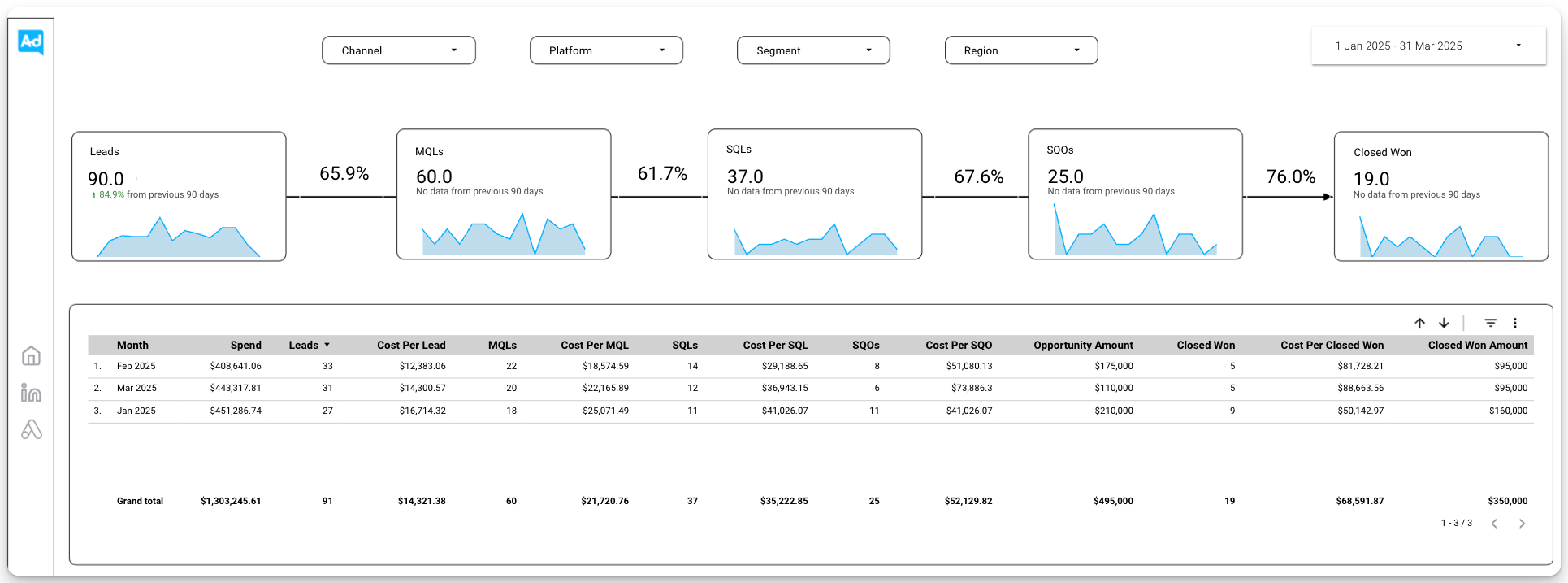
The customizable views let you analyze key performance indicators (KPIs) by platform, life cycle stage, or across all channels.
While these dashboards track pipeline, efficiency, and revenue metrics first, they also show impressions, click-through rates (CTRs), and conversion rates. So, you get both marketing and revenue data in one place.
What Are the Best Tools for Tracking B2B Pay-Per-Click ROI?
The best tools for tracking pay-per-click ROI help you collect, connect, and analyze campaign data from every stage of the buyer’s journey.
CRM systems
CRM systems, like HubSpot and Salesforce, keep all your lead, pipeline, customer, and revenue data in one place.
These platforms track what happens after each click, so you can see which ads generate SQLs, opportunities, and closed-won deals.
CRMs also help your marketing and sales teams share the same life cycle data, which makes attribution and ROI reporting much more accurate.
Attribution tools
Attribution tools, such as Dreamdata, HockeyStack, and Factors.ai, show how all your marketing activities work together to influence the buyer’s journey.
They track every touchpoint, including paid advertising, SEO, paid social, content, email marketing, and sales outreach.
These platforms give you a more realistic view of marketing ROI because they assign conversion credit where it’s due.
Analytics platforms
Google Analytics 4 (GA4) remains the most widely used PPC analytics platform because it’s free, flexible, and integrates easily with most marketing tools.
This tool can track traffic and conversions from Google, LinkedIn, Meta, TikTok, Reddit, and YouTube ads.
GA4 also helps you analyze landing page performance, user behavior, conversion paths, and engagement metrics.
Unfortunately, GA4 still struggles with long B2B sales cycles, offline conversions, and multi-touch attribution. So, it can’t give you the full picture on its own.
AI ad optimization tools
AI ad optimization tools track PPC performance and also react to issues in real time. They spot wasted ad spend and performance drops and optimize campaigns while they’re running, to improve ROI.
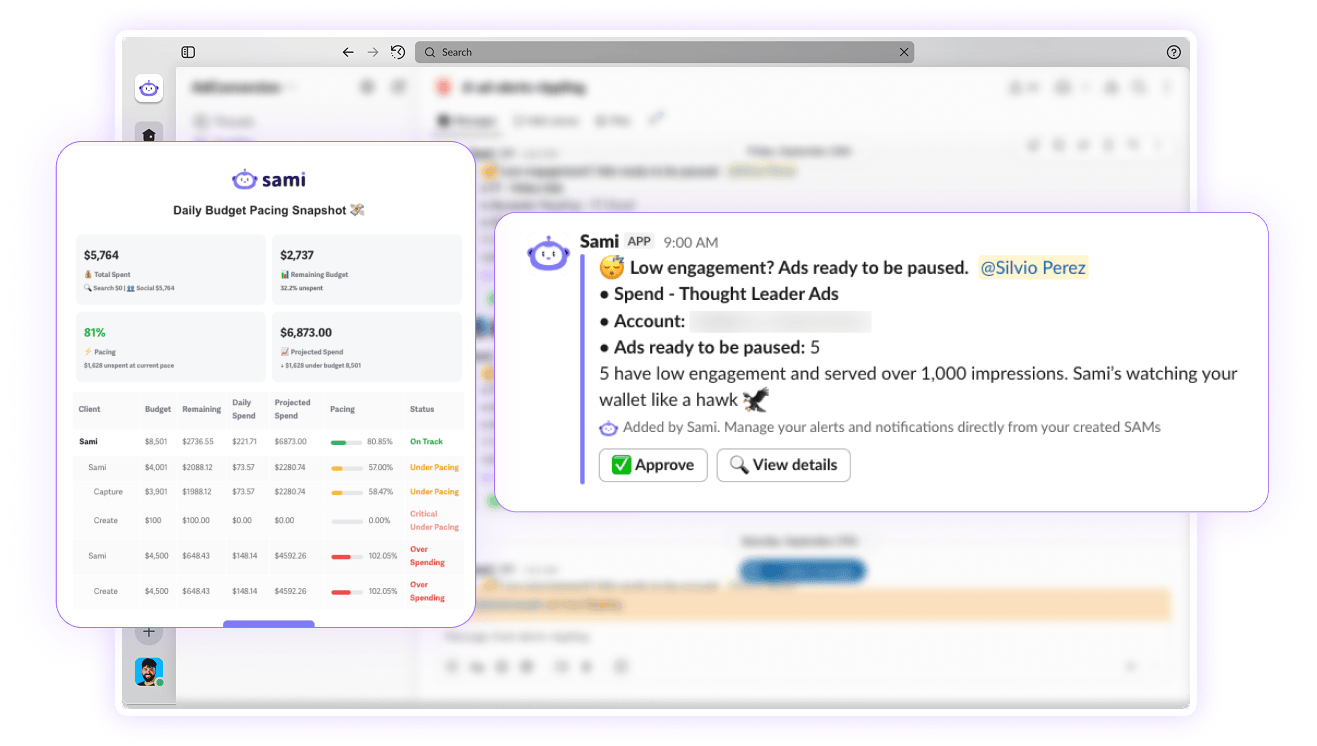
AdConversion’s proprietary AI tool, Sami, monitors your LinkedIn, Google, Meta, and YouTube ads 24/7. If one of your ads starts underperforming, overspending, or showing signs of ad fatigue, Sami pauses it right away.
This tool can also adjust bids and reallocate budgets based on performance to make sure you don’t waste any money.
Your marketing team will always know what’s going on because Sami sends Slack or email alerts for every action it takes, paired with a daily budget pacing summary.
Which Attribution Models Work Best for B2B PPC Advertising?
Multi-touch attribution models that give conversion credit to multiple campaigns and buyer interactions work best for B2B PPC advertising.
Pick one of these three models based on your sales cycle complexity, business goals, and reporting needs.
Linear attribution
Linear attribution gives equal value to every touchpoint in the customer’s journey.
If someone clicks a LinkedIn ad, visits through organic social media, and later converts through Google ads, each interaction influences the final conversion equally.
This model gives you a broader view of PPC ROI because it shows all the campaigns involved in producing opportunities and revenue.
Time-decay attribution
Time-decay attribution places more importance on touchpoints that happen closer to conversion while still recognizing earlier interactions.
A demo request or branded search click receives more attribution weight than an ad someone clicked three months earlier.
This model helps you identify which campaigns push buyers toward demo calls, sales conversations, and purchase decisions later in the customer journey.
W-shaped attribution
W-shaped attribution focuses on three key moments in the buyer’s journey: first touch, lead creation, and opportunity creation. It then distributes the remaining attribution value across the other interactions.
This model offers better visibility into pipeline generation and revenue progression throughout the sales cycle.
What Are the Most Common B2B Pay-Per-Click ROI Tracking Mistakes?
The biggest B2B PPC ROI tracking mistakes happen when you rely on incomplete data or focus on the wrong metrics:
- Tracking only leads instead of revenue. A campaign can generate tons of form fills and still produce very few opportunities or closed deals.
- Relying too much on last-click attribution. This model gives all the attention to the final conversion source while ignoring past campaigns that helped get new customers across the finish line.
- Forgetting about offline conversions. Most B2B buyers engage with your business outside the ad platform, so missing this data creates huge attribution gaps.
- Using messy UTM naming conventions. If every PPC campaign uses different labels, your CRM and analytics reports will be unreliable.
- Leaving out key expenses from ROI calculations. If you only track ad spend and don’t take into account in-house resources, agency retainers, and software subscriptions, you’re not painting an accurate picture.
How Do You Report Pay-Per-Click ROI to Executives?
To effectively report pay-per-click ROI to executives, you need to tie campaign performance to business goals, revenue impact, and future growth.
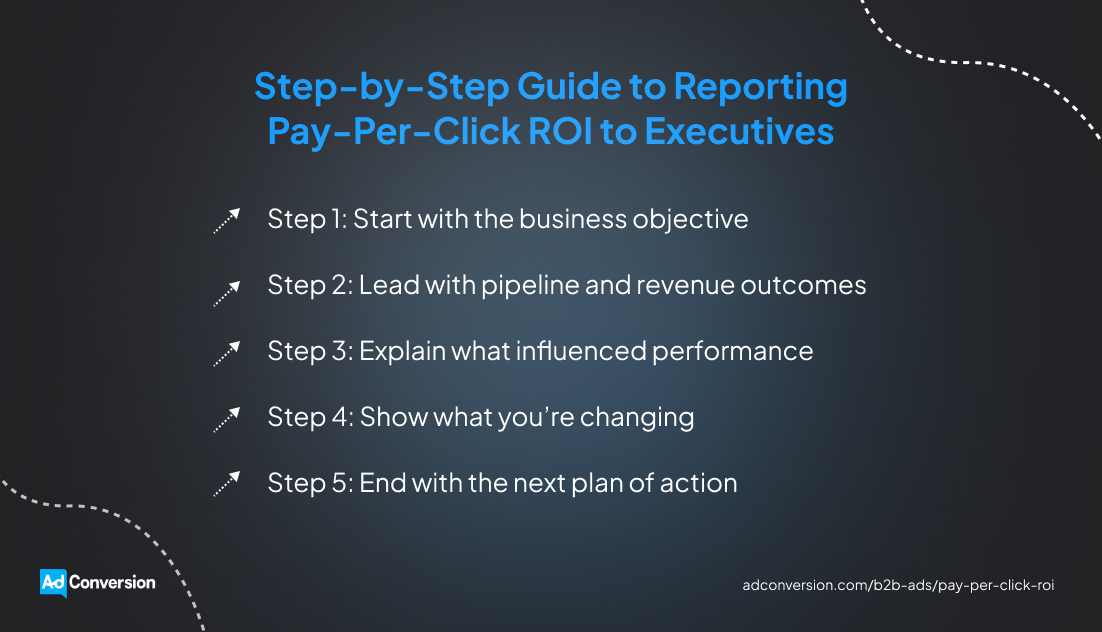
Step 1: Start with the business objective
Before showing any data, remind leadership what the campaigns were designed to accomplish. That gives the numbers context right away.
Maybe the goal was generating more opportunities from enterprise buyers or lowering customer acquisition cost in a specific market. Once everyone understands the objective, the rest of the report becomes much easier to follow.
Step 2: Lead with pipeline and revenue outcomes
Don’t bury the most important numbers halfway through the presentation. Executives want to see opportunities, revenue, and profitability first.
Lead with metrics like SQLs, pipe-to-spend ratio, ROAS, and closed-won revenue. This immediately shows whether PPC contributes to pipeline and business growth.
Step 3: Explain what influenced performance
Make sure you don’t just dump numbers into a dashboard. Explain which ad groups, audience segments, messaging, or channels actually influenced results.
Specific insights make reports more persuasive. Saying a LinkedIn campaign reduced cost per SQL by 25% tells a much better story than simply saying “performance improved.”
Step 4: Show what you’re changing
Leadership knows not every campaign will perform perfectly. What matters is how quickly your team reacts.
Talk openly about budget shifts, A/B testing results, underperforming campaigns, and data-driven decisions. This shows executives that you’re actively optimizing paid programs and marketing spend for better ROI.
Step 5: End with the next plan of action
Close the report with what comes next. You can cover upcoming PPC priorities, retargeting campaigns, budget allocation changes, testing plans, or revenue goals you expect to hit next quarter.
Ending with future priorities shows execs that digital marketing is a true growth partner.
Final Thoughts
Measuring B2B pay-per-click ROI gets much easier once your tracking, attribution, and reporting systems finally work together.
When you can connect ad campaigns to pipeline and revenue, you stop making decisions based on guesses and start investing where it matters.
In the end, to win big with PPC advertising, you need to keep a close eye on performance and optimize faster than everyone else.
If you need help tracking or improving PPC ROI, have a quick chat with AdConversion.

.png)
Related Articles
How to Improve Lead Quality from B2B Ads
How to Track and Measure B2B Pay-Per-Click ROI

Top 12 B2B SaaS Marketing Agencies: A Detailed List [2026]
Join 0,000 B2B marketers leveling up their paid advertising skill set! 🚀
Join 0,000 B2B marketers leveling up their paid advertising skill set! 🚀


