



How to Create Tracking Templates in Google Ads
%20-%20new%20v2.png)
Hey there, Digital Marketer. Do you cringe a little when you hear the words “setting up tracking in an ad channel”? 😅
Tracking may be the unsexy side of marketing, but I promise that Google Ads Tracking Templates are simpler than they sound.
In this article, I’ll show you how to set up tracking right, capture accurate data, and see what’s really driving your conversions and revenue.
Let’s dive in! 👇
TABLE OF CONTENTS:
- What is a Google Ads Tracking Template?
- How to install Tracking Templates in Google Ads
- Benefits of adding Tracking Templates to your campaigns
- From clicks to conversions: Master Google Ads for B2B
What is a Google Ads Tracking Template?
Tracking templates allow you to streamline your link tagging process and pass static and dynamic values.
I created this little cheat sheet for you here to give you an understanding of a tracking template.
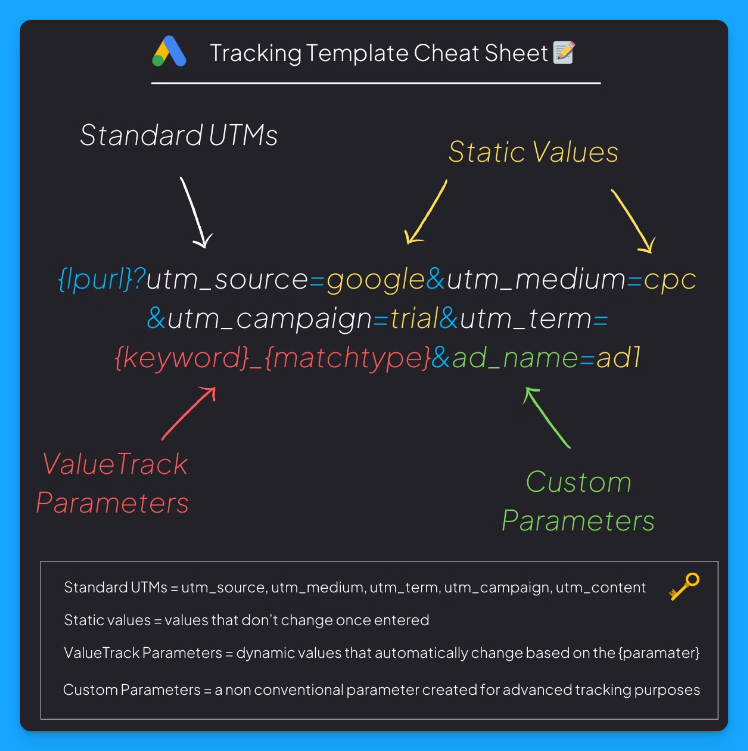
Here’s what each parameter means:
- {lpurl}: This is your landing page URL. So whatever the URL is in your ad, the template will automatically inherit it and then automatically append these different static and dynamic values based on these parameters.
- UTMs: These are your standard UTMs, like UTM source, UTM medium, campaign, term, and content.
Check out our Free UTM Tagger Tool to easily create them in bulk and for more info about each parameter. - Static Values: Static means it’s always the same, it’ll remain consistent. So a static value will always be a text.
So in the image example above, we always want the UTM Source to be google, the UTM Medium to be cpc, and the UTM Campaign to be trial. - Dynamic Values: Dynamic means it changes. The values here usually have squiggly brackets like {keyword} or {matchtype}, which tell Google Ads to populate that field dynamically.
For example, with {keyword}, the UTM Term will automatically insert the keyword that drove the click, giving you granular detail on the search behavior driving each visit. - Custom Parameters: These are parameters you can create that are not part of the UTM parameters, which are your standard ones.
You’ll probably want to use custom UTM parameters if you have some sort of advanced tracking setup.
Anything that is available in the URL, you can then set up with JavaScript the ability to pass the data from those parameters into hidden fields in your form, to then be able to route and track and do all sorts of things in your backend.
In the cheat sheet above, the ad_name parameter will give you details about which ad drove the visit.
So this is a tracking template, and it’s really important as this is going to allow you to get a lot better data and ultimately, better insights from your activities.
How to Install a Tracking Template in Google Ads
You can install a tracking template at the campaign, ad group, or ad level. You could even do it at the account level with the tracking script, but I recommend that you start off at the campaign level.
Here are the steps you need to follow in your Google Ads account 👇
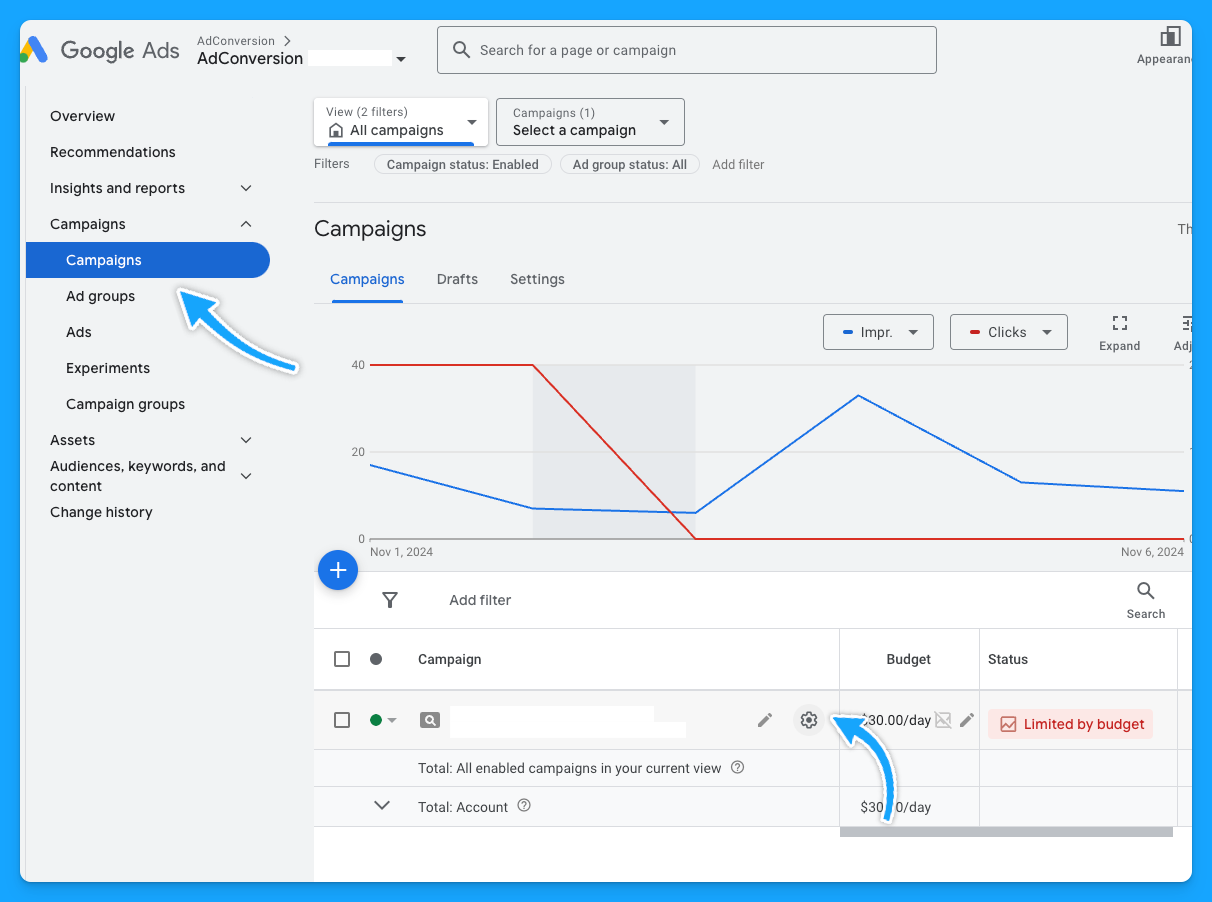
- Open your account, then open the campaigns tab and choose one campaign. Now go into the settings by clicking on this little gear.
- Scroll down to additional settings.

- Go to the Campaign URL options and paste your tracking template in the “Tracking Template” field.
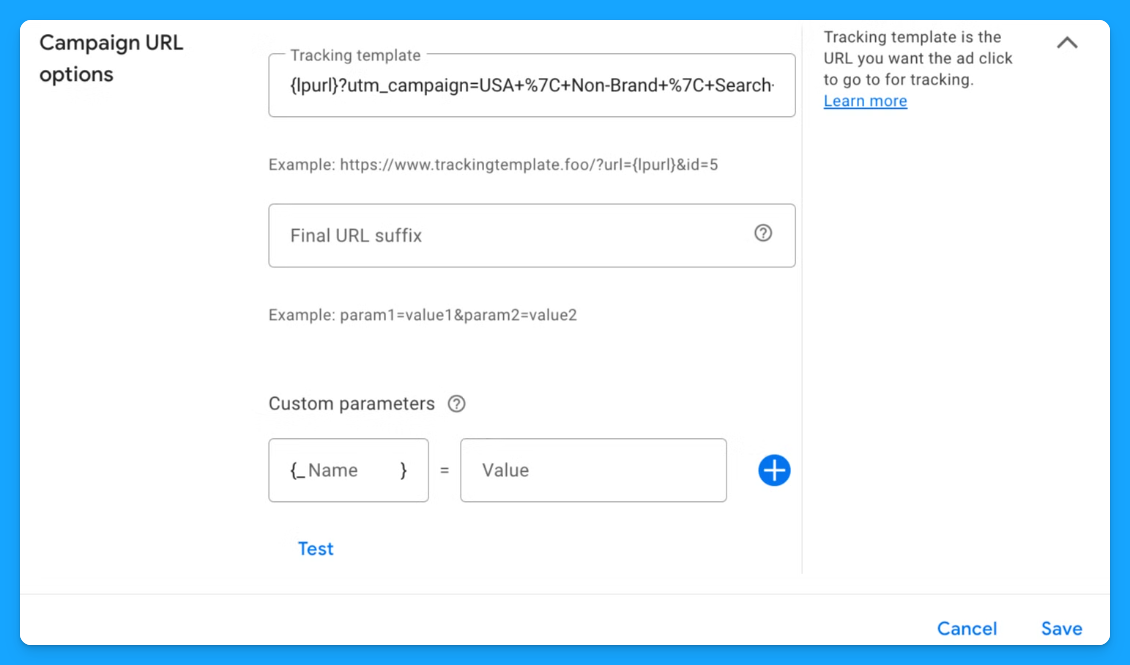
Here you’ll want to follow the format from the cheat sheet I shared at the beginning of this article because that is the syntax of the tracking template.
To be easier, you can copy this tracking template below and just add your static values in the highlighted fields:
{lpurl}?utm_source=entersource&utm_medium=entermedium&utm_campaign=entercampaign&utm_term={keyword}_{matchtype}&ad_name=enteradname
- UTM Source: People usually use Google or AdWords.
- UTM Medium: People usually put CPC or paid search. This 100% depends on you and your business, your company, and how you want to track things.
- UTM Campaign: You can put the name of your campaign. The downside is that you have to do this for each campaign.
- UTM Term: This will dynamically push the keyword that drove the click and the match type.
- Ad_Name (custom parameter): This is 100% optional, and most of the clients from our agency don’t really need custom parameters, but I just want you to be aware of it.
Once you’ve mastered basic tracking, custom parameters can add another layer of insights by capturing non-standard data. For instance, if you want to differentiate ad variations, you could set a custom parameter like ad_name=RSA1.
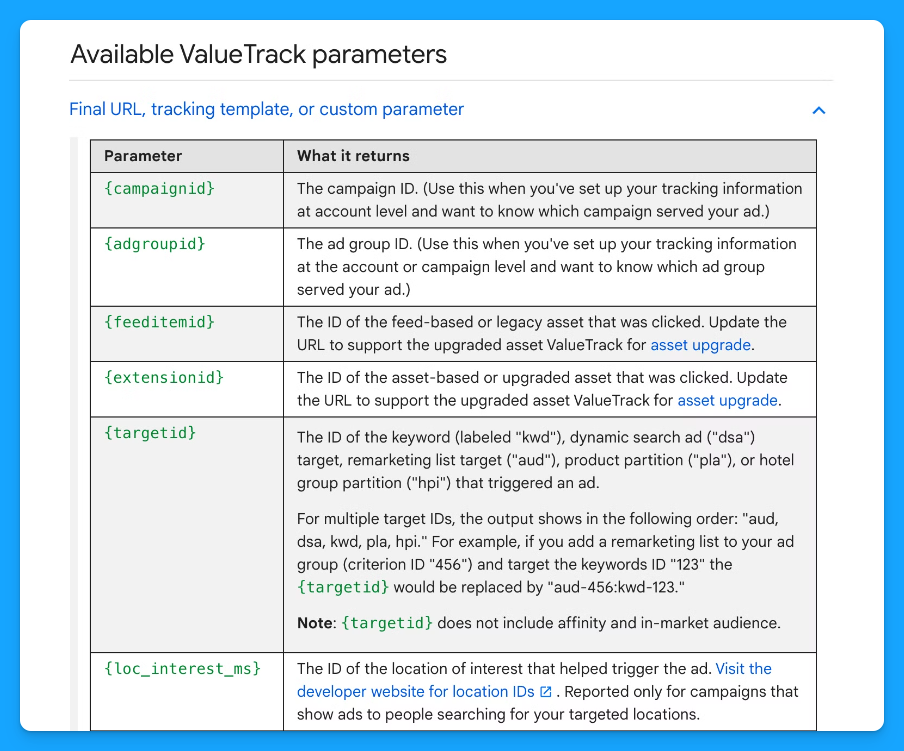
You can also find all the Value Track Parameters Google supports here:
I usually like to set my tracking templates at the campaign level, which suffices. So, in this case, each campaign must have a unique tracking template.
Another cool thing about the tracking template is once you create the tracking template at the campaign level, you no longer have to worry about tagging your ads with UTM parameters at the ad level.
It'll automatically inherit the campaign URL tracking template and tag your links appropriately.
If you're just putting all of the tagged URLs at the ad level, it can be really problematic sometimes and time-consuming to make changes and miss things. This helps streamline things and push those dynamic parameters.
Benefits of Adding Tracking Templates to Your Campaigns
Setting up tracking templates in Google Ads is a powerful way to automate link tagging and capture high-quality data.
The better data we pass through our tracking template, the more insights we can receive.
With standard UTMs, dynamic parameters, and custom fields, you’ll get a clear view of what’s driving performance and find better ways to allocate budget, optimize campaigns, and ultimately boost results. 🚀
Why deny yourself incredible insights such as “which keywords drive the most revenue?..” when you can capture that information at no additional cost?
That’s it about tracking templates! 🎉
Now go build your first one and let the data guide your ad strategies! 🤓
I hope you found this article useful!
From Clicks to Conversions: Master Google Ads for B2B 🔥
If you want to become a Google Ads pro, check out our free B2B Google Ads courses, where you'll learn how to launch, optimize, and scale your campaigns to drive pipeline and revenue.

Here's what you'll learn in each course:
⚙️ B2B Google Ads 101 - How to Launch Dangerously Effective Campaigns for Beginners
- The Googleverse: The Game You're Playing & How To Win
- Measurement: How to Make Sure You're Profitable
- Targeting: How to Show Up For the Right Searcher
- Planning: Putting It All Together
🎯 Google Ads 102 - How to Clicks Into Profit
- Visibility: How To Find the Hole Sucking Profits
- Workflows: How to Optimize On a Daily, Weekly, Monthly & Quarterly Basis
- Experimentation: How to Test & Automate Profitability
- Troubleshooting: How To Solve Inevitable Problems
🚀 Google Ads 103 - How to Scale Google Ads For Advanced Advertisers
- Methodology: How to Vertically Scale Google Ads From A-Z
- Campaigns: Scaling Horizontally Through Campaign Themes
- Channels: Scaling Outside of Paid Search
Click Here to Join 1,000+ B2B Marketers Today and start leveling up your advertising skill set.
Takes < 90 seconds to sign up (seriously we timed it 😂)
People Also Ask
What is a tracking template in Google Ads?
A tracking template is a URL parameter setup in Google Ads that appends tracking information to your landing page URLs. This allows you to monitor specific details about ad clicks, such as the campaign, ad group, keyword, and device involved. 
Why should I use tracking templates in my campaigns?
Implementing tracking templates automates link tagging, ensuring consistent and accurate data collection across your campaigns. This leads to better insights into performance metrics, enabling more informed optimization decisions. 
How do I set up a tracking template in Google Ads?
To set up a tracking template:
- Log in to your Google Ads account.
- Navigate to the desired account, campaign, ad group, or ad level.
- Click on “Settings” and then “Additional settings.”
- Under “Tracking,” enter your tracking template URL, incorporating the necessary ValueTrack parameters.
- Save your changes.
This setup enables dynamic tracking of various metrics. 
What are ValueTrack parameters, and how do they work in tracking templates?
ValueTrack parameters are dynamic URL components that capture specific information about each ad click, such as the device used ({device}), the keyword that triggered the ad ({keyword}), and the campaign ID ({campaignid}). When a user clicks your ad, these placeholders are replaced with actual data, allowing for detailed performance analysis. 
How can I test if my tracking template is working correctly?
After setting up your tracking template, use the “Test” button in the “Tracking” section of your Google Ads account settings. This function combines your final URL with the tracking parameters to ensure it directs to the correct landing page and that all parameters are functioning as intended.

Heading 1
Heading 2
Heading 3
Heading 4
Heading 5
Heading 6
Lorem ipsum dolor sit amet, consectetur adipiscing elit, sed do eiusmod tempor incididunt ut labore et dolore magna aliqua. Ut enim ad minim veniam, quis nostrud exercitation ullamco laboris nisi ut aliquip ex ea commodo consequat. Duis aute irure dolor in reprehenderit in voluptate velit esse cillum dolore eu fugiat nulla pariatur.
Block quote
Ordered list
- Item 1
- Item 2
- Item 3
Unordered list
- Item A
- Item B
- Item C
Bold text
Emphasis
Superscript
Subscript

Heading
Heading 1
Heading 2
Heading 3
Heading 4
Heading 5
Heading 6
Lorem ipsum dolor sit amet, consectetur adipiscing elit, sed do eiusmod tempor incididunt ut labore et dolore magna aliqua. Ut enim ad minim veniam, quis nostrud exercitation ullamco laboris nisi ut aliquip ex ea commodo consequat. Duis aute irure dolor in reprehenderit in voluptate velit esse cillum dolore eu fugiat nulla pariatur.
Block quote
Ordered list
- Item 1
- Item 2
- Item 3
Unordered list
- Item A
- Item B
- Item C
Bold text
Emphasis
Superscript
Subscript
Heading
Heading 1
Heading 2
Heading 3
Heading 4
Heading 5
Heading 6
Lorem ipsum dolor sit amet, consectetur adipiscing elit, sed do eiusmod tempor incididunt ut labore et dolore magna aliqua. Ut enim ad minim veniam, quis nostrud exercitation ullamco laboris nisi ut aliquip ex ea commodo consequat. Duis aute irure dolor in reprehenderit in voluptate velit esse cillum dolore eu fugiat nulla pariatur.
Block quote
Ordered list
- Item 1
- Item 2
- Item 3
Unordered list
- Item A
- Item B
- Item C
Bold text
Emphasis
Superscript
Subscript
Heading
Heading 1
Heading 2
Heading 3
Heading 4
Heading 5
Heading 6
Lorem ipsum dolor sit amet, consectetur adipiscing elit, sed do eiusmod tempor incididunt ut labore et dolore magna aliqua. Ut enim ad minim veniam, quis nostrud exercitation ullamco laboris nisi ut aliquip ex ea commodo consequat. Duis aute irure dolor in reprehenderit in voluptate velit esse cillum dolore eu fugiat nulla pariatur.
Block quote
Ordered list
- Item 1
- Item 2
- Item 3
Unordered list
- Item A
- Item B
- Item C
Bold text
Emphasis
Superscript
Subscript
Heading
Heading 1
Heading 2
Heading 3
Heading 4
Heading 5
Heading 6
Lorem ipsum dolor sit amet, consectetur adipiscing elit, sed do eiusmod tempor incididunt ut labore et dolore magna aliqua. Ut enim ad minim veniam, quis nostrud exercitation ullamco laboris nisi ut aliquip ex ea commodo consequat. Duis aute irure dolor in reprehenderit in voluptate velit esse cillum dolore eu fugiat nulla pariatur.
Block quote
Ordered list
- Item 1
- Item 2
- Item 3
Unordered list
- Item A
- Item B
- Item C
Bold text
Emphasis
Superscript
Subscript
Heading
Heading 1
Heading 2
Heading 3
Heading 4
Heading 5
Heading 6
Lorem ipsum dolor sit amet, consectetur adipiscing elit, sed do eiusmod tempor incididunt ut labore et dolore magna aliqua. Ut enim ad minim veniam, quis nostrud exercitation ullamco laboris nisi ut aliquip ex ea commodo consequat. Duis aute irure dolor in reprehenderit in voluptate velit esse cillum dolore eu fugiat nulla pariatur.
Block quote
Ordered list
- Item 1
- Item 2
- Item 3
Unordered list
- Item A
- Item B
- Item C
Bold text
Emphasis
Superscript
Subscript
Heading
Heading 1
Heading 2
Heading 3
Heading 4
Heading 5
Heading 6
Lorem ipsum dolor sit amet, consectetur adipiscing elit, sed do eiusmod tempor incididunt ut labore et dolore magna aliqua. Ut enim ad minim veniam, quis nostrud exercitation ullamco laboris nisi ut aliquip ex ea commodo consequat. Duis aute irure dolor in reprehenderit in voluptate velit esse cillum dolore eu fugiat nulla pariatur.
Block quote
Ordered list
- Item 1
- Item 2
- Item 3
Unordered list
- Item A
- Item B
- Item C
Bold text
Emphasis
Superscript
Subscript
Heading
Heading 1
Heading 2
Heading 3
Heading 4
Heading 5
Heading 6
Lorem ipsum dolor sit amet, consectetur adipiscing elit, sed do eiusmod tempor incididunt ut labore et dolore magna aliqua. Ut enim ad minim veniam, quis nostrud exercitation ullamco laboris nisi ut aliquip ex ea commodo consequat. Duis aute irure dolor in reprehenderit in voluptate velit esse cillum dolore eu fugiat nulla pariatur.
Block quote
Ordered list
- Item 1
- Item 2
- Item 3
Unordered list
- Item A
- Item B
- Item C
Bold text
Emphasis
Superscript
Subscript
Heading
Heading 1
Heading 2
Heading 3
Heading 4
Heading 5
Heading 6
Lorem ipsum dolor sit amet, consectetur adipiscing elit, sed do eiusmod tempor incididunt ut labore et dolore magna aliqua. Ut enim ad minim veniam, quis nostrud exercitation ullamco laboris nisi ut aliquip ex ea commodo consequat. Duis aute irure dolor in reprehenderit in voluptate velit esse cillum dolore eu fugiat nulla pariatur.
Block quote
Ordered list
- Item 1
- Item 2
- Item 3
Unordered list
- Item A
- Item B
- Item C
Bold text
Emphasis
Superscript
Subscript
Heading
Heading 1
Heading 2
Heading 3
Heading 4
Heading 5
Heading 6
Lorem ipsum dolor sit amet, consectetur adipiscing elit, sed do eiusmod tempor incididunt ut labore et dolore magna aliqua. Ut enim ad minim veniam, quis nostrud exercitation ullamco laboris nisi ut aliquip ex ea commodo consequat. Duis aute irure dolor in reprehenderit in voluptate velit esse cillum dolore eu fugiat nulla pariatur.
Block quote
Ordered list
- Item 1
- Item 2
- Item 3
Unordered list
- Item A
- Item B
- Item C
Bold text
Emphasis
Superscript
Subscript
Heading
Heading 1
Heading 2
Heading 3
Heading 4
Heading 5
Heading 6
Lorem ipsum dolor sit amet, consectetur adipiscing elit, sed do eiusmod tempor incididunt ut labore et dolore magna aliqua. Ut enim ad minim veniam, quis nostrud exercitation ullamco laboris nisi ut aliquip ex ea commodo consequat. Duis aute irure dolor in reprehenderit in voluptate velit esse cillum dolore eu fugiat nulla pariatur.
Block quote
Ordered list
- Item 1
- Item 2
- Item 3
Unordered list
- Item A
- Item B
- Item C
Bold text
Emphasis
Superscript
Subscript
Heading
Heading 1
Heading 2
Heading 3
Heading 4
Heading 5
Heading 6
Lorem ipsum dolor sit amet, consectetur adipiscing elit, sed do eiusmod tempor incididunt ut labore et dolore magna aliqua. Ut enim ad minim veniam, quis nostrud exercitation ullamco laboris nisi ut aliquip ex ea commodo consequat. Duis aute irure dolor in reprehenderit in voluptate velit esse cillum dolore eu fugiat nulla pariatur.
Block quote
Ordered list
- Item 1
- Item 2
- Item 3
Unordered list
- Item A
- Item B
- Item C
Bold text
Emphasis
Superscript
Subscript
Heading
Heading 1
Heading 2
Heading 3
Heading 4
Heading 5
Heading 6
Lorem ipsum dolor sit amet, consectetur adipiscing elit, sed do eiusmod tempor incididunt ut labore et dolore magna aliqua. Ut enim ad minim veniam, quis nostrud exercitation ullamco laboris nisi ut aliquip ex ea commodo consequat. Duis aute irure dolor in reprehenderit in voluptate velit esse cillum dolore eu fugiat nulla pariatur.
Block quote
Ordered list
- Item 1
- Item 2
- Item 3
Unordered list
- Item A
- Item B
- Item C
Bold text
Emphasis
Superscript
Subscript
Heading
Heading 1
Heading 2
Heading 3
Heading 4
Heading 5
Heading 6
Lorem ipsum dolor sit amet, consectetur adipiscing elit, sed do eiusmod tempor incididunt ut labore et dolore magna aliqua. Ut enim ad minim veniam, quis nostrud exercitation ullamco laboris nisi ut aliquip ex ea commodo consequat. Duis aute irure dolor in reprehenderit in voluptate velit esse cillum dolore eu fugiat nulla pariatur.
Block quote
Ordered list
- Item 1
- Item 2
- Item 3
Unordered list
- Item A
- Item B
- Item C
Bold text
Emphasis
Superscript
Subscript
Heading
Heading 1
Heading 2
Heading 3
Heading 4
Heading 5
Heading 6
Lorem ipsum dolor sit amet, consectetur adipiscing elit, sed do eiusmod tempor incididunt ut labore et dolore magna aliqua. Ut enim ad minim veniam, quis nostrud exercitation ullamco laboris nisi ut aliquip ex ea commodo consequat. Duis aute irure dolor in reprehenderit in voluptate velit esse cillum dolore eu fugiat nulla pariatur.
Block quote
Ordered list
- Item 1
- Item 2
- Item 3
Unordered list
- Item A
- Item B
- Item C
Bold text
Emphasis
Superscript
Subscript
Heading
Heading 1
Heading 2
Heading 3
Heading 4
Heading 5
Heading 6
Lorem ipsum dolor sit amet, consectetur adipiscing elit, sed do eiusmod tempor incididunt ut labore et dolore magna aliqua. Ut enim ad minim veniam, quis nostrud exercitation ullamco laboris nisi ut aliquip ex ea commodo consequat. Duis aute irure dolor in reprehenderit in voluptate velit esse cillum dolore eu fugiat nulla pariatur.
Block quote
Ordered list
- Item 1
- Item 2
- Item 3
Unordered list
- Item A
- Item B
- Item C
Bold text
Emphasis
Superscript
Subscript
Heading
Heading 1
Heading 2
Heading 3
Heading 4
Heading 5
Heading 6
Lorem ipsum dolor sit amet, consectetur adipiscing elit, sed do eiusmod tempor incididunt ut labore et dolore magna aliqua. Ut enim ad minim veniam, quis nostrud exercitation ullamco laboris nisi ut aliquip ex ea commodo consequat. Duis aute irure dolor in reprehenderit in voluptate velit esse cillum dolore eu fugiat nulla pariatur.
Block quote
Ordered list
- Item 1
- Item 2
- Item 3
Unordered list
- Item A
- Item B
- Item C
Bold text
Emphasis
Superscript
Subscript
Heading
Heading 1
Heading 2
Heading 3
Heading 4
Heading 5
Heading 6
Lorem ipsum dolor sit amet, consectetur adipiscing elit, sed do eiusmod tempor incididunt ut labore et dolore magna aliqua. Ut enim ad minim veniam, quis nostrud exercitation ullamco laboris nisi ut aliquip ex ea commodo consequat. Duis aute irure dolor in reprehenderit in voluptate velit esse cillum dolore eu fugiat nulla pariatur.
Block quote
Ordered list
- Item 1
- Item 2
- Item 3
Unordered list
- Item A
- Item B
- Item C
Bold text
Emphasis
Superscript
Subscript
Heading
Heading 1
Heading 2
Heading 3
Heading 4
Heading 5
Heading 6
Lorem ipsum dolor sit amet, consectetur adipiscing elit, sed do eiusmod tempor incididunt ut labore et dolore magna aliqua. Ut enim ad minim veniam, quis nostrud exercitation ullamco laboris nisi ut aliquip ex ea commodo consequat. Duis aute irure dolor in reprehenderit in voluptate velit esse cillum dolore eu fugiat nulla pariatur.
Block quote
Ordered list
- Item 1
- Item 2
- Item 3
Unordered list
- Item A
- Item B
- Item C
Bold text
Emphasis
Superscript
Subscript
Heading
Heading 1
Heading 2
Heading 3
Heading 4
Heading 5
Heading 6
Lorem ipsum dolor sit amet, consectetur adipiscing elit, sed do eiusmod tempor incididunt ut labore et dolore magna aliqua. Ut enim ad minim veniam, quis nostrud exercitation ullamco laboris nisi ut aliquip ex ea commodo consequat. Duis aute irure dolor in reprehenderit in voluptate velit esse cillum dolore eu fugiat nulla pariatur.
Block quote
Ordered list
- Item 1
- Item 2
- Item 3
Unordered list
- Item A
- Item B
- Item C
Bold text
Emphasis
Superscript
Subscript
Heading
Once you understand the basics and set up initial campaigns, start A/B testing and experimenting. You could test many things, for example, different ad formats, creatives, messaging, campaign objectives or targeting - all of which can lead to better performance. From my experience, any significant improvement in advertising efficiency starts with a (sometimes random and "long shot") test. To make the testing process smooth and successful, I recommend starting with a hypothesis, creating a testing plan, and having clear KPIs and ways of tracking those.

Kris Wojcik
#1 tip for marketers getting into B2B advertising is to have fun with it. A lot of B2B brands take themselves really seriously to appeal to Enterprise buyers, but the reality is we're all human and you're marketing to humans.

Jess Bahr
People buy different, not better. So when you're advertising in B2B, it's crucial to sniff out your differentiator and explain that in a way that your buyers will clearly understand it, consume it, and resonate with it. Each of your buyers is different too so it's important to have a good mix of how you explain the difference.

Tim Davidson
One valuable tip I'd offer new marketers entering the realm of B2B advertising is to prioritize understanding your target audience deeply. B2B advertising differs significantly from B2C advertising in that you're not just targeting individual consumers but engaging with businesses, often involving nuanced decision-making units.
To effectively connect with your B2B audience, invest time researching and profiling your ideal customer profile (ICP). This means identifying their industry, company size, and job roles and delving into their pain points, challenges, and aspirations – try to get in the minds of your ICP from entry-level to executive.
By going that extra mile in understanding your audience, you can craft messaging and content that resonates with them—addressing their specific needs, providing solutions, and positioning your products or services as the standout choice.

Tyler Ray
Before you create any adverts, you need to figure out what your message is going to be. Don't rush into it until you know 'what problems you solve, how you solve them, and why your customer should solve them.' One sentence on each of those creates your elevator pitch, which should be present in some way, in all of your ads. It also represents the business case for your product. If you can't explain your story easily, how on earth do you expect your audience to remember it?

Joseph Hill
You know that crazy Marketing 'funnel' everyone talks about? Always start from the bottom up. Meaning, the first place to start is to know who your customers are and how they equate to revenue. Then work yourself up the funnel to drive the most impact.

Bryttney Blanken
Adopt the 'kill your darlings' mantra. You have to be ready to cut what you love if it isn't delivering results—be it an ad, keyword, or campaign. What was once a good performer might not stay that way, so never 'set and forget.' Always monitor and optimise.
Three macroeconomic principles should guide you:
1- Budget is limited.
2- Benchmark against your own metrics, not industry fluff.
3- Make trade-offs based on what performs better.
Kill the darlings that don't contribute to the revenue to make room for what does.

Canberk Beker
Focus on the audience/ICP first, not being the best/all-in-one product. When you address the pain and call the audience out, it resonates far more than simply stating 'We're #1/the best in ... category'. No one gives a shit about fancy review badges, Gartner, or other reports (maybe just a tiny bit) & enterprise studies/research. Everyone wants to know how your product will solve their pain or problem.
The best way (for me at least) to find out the actual problem of a customer is to go to G2 and your biggest/well-known competitor and read/scrape all the 'What problems is PandaDoc solving and how is that benefiting you?' answers. You'll find out that most answers are about one/two specific cases, and so then it's your job to address it right via website/ad copy messaging.

Alex Panchuk
Shift your mindset. You'll generate leads, but it's not just about lead generation. When they convert, focus on quality and intent. To do that, you need to understand the customer and how to reach them with the right and interesting message in the right places, consistently. Make it easy for them to remember you, find you, and buy from you when they are ready. For practical advice, Go through the LinkedIn ebook 'How B2B Brands Grow", study demand generation, join communities, and ask questions there.

Roman Krs
Before you blame the channel, do the research to see if there are some other reasons why leads aren't converting to opportunities.
For example:
WEBSITE
- Does the ad align with the landing page?
- Is it easy to understand how it works, who it's for, how much it costs, and the outcome it drives?
- Do you have relevant social proof?
CONVERSION
- Is the form simple and short?
- Does it offer an easy way to schedule a meeting?
- Are there clear CTAs across the website?
- Do you address common objections on the demo page?
LEAD HAND-OFF
- How long does it take to set up a meeting with a buyer after the form is filled take?
- Did we align the follow-up with the intent level?
- Do we offer a demo at the first meeting?
- Do we identify the core problems of the buyer and how our solution can help solve those issues?
SALES CYCLE
- Did we create a close plan?
- Have we gotten all key decision-makers involved?
- Do we add value along the sales process?
- Do we always set up the next meeting with a clear agenda?
- Have we properly differentiated ourselves against competitors and keeping with the status quo?
80% of the above don't directly involve the "channel"

Jonathan Bland
For someone starting with B2B advertising, I highly recommend following the right B2B content creators on LinkedIn, as well as other paid media ones - then block some time to go through their posts/videos to learn new strategies/tips, or merely understand their point-of-view. Then, find ways of testing those strategies/quick wins with your own clients to get your own insights and takeaways - plus, it's a great way of implementing what you learn

Gonçalo Prates
Make sure that you nail your fundamentals before you launch your campaign. Know where your ICP spends time online and what they are searching for.
If you don't, you won't be able to nail down your targeting for paid social and you won't go after the right keywords on paid search.
Start with the understanding of your buyer (the qualitative and quantitative) insights, and then go and build your strategy based off of that. There are a lot of great resources on how to technically set up your campaign - just keep it as simple as you can to begin with.
The final part of the fundamentals is to make sure you have tracking in place in your CRM. You need to be able to know what leads came in from your paid ads, and be able to track them throughout the sales process. Otherwise you'll never be able to answer the question at the executive level, "How are our ads performing?

Blake Strozyk
Seasonality in B2B is real & should be taken into account when optimizing & experimenting with paid ads.
Here is what I mean: We have grown very rapidly over the last 1.5 years and therefore don't have reliable base data from last summer, so only this year we started to feel the summer slow down properly. Many experiments that we ran have to be pre & post (sometimes it's technically not possible to run A/B), so if you launch an experiment in June & compare results with May the results will be heavily impacted by external factors (summer period slowdown).
It's not something new, but something we faced a lot this summer. So don't disregard the importance of taking seasonality into account.

Borys Khodan
1. When building advertising campaigns, be hyper focused on audience and targeting. Your best advertising campaign won't be successful unless you target the right people at the right time.
2. The biggest gold mine for ad copy is customer calls. If you have a tool like Gong, you should be listening to calls every day to find insights on what your customers care about.

Liam Barnes
The B2B Buyer's journey is complex, make sure you are filling all the content gaps on your paid ad strategy.

Miguel Sánchez
Offers are the most underused and underappreciated lever in B2B ad performance, and it’s not even close.
People associate Offers with e-commerce style, “buy one get one free” marketing messages. But the category is so much broader than that - it’s offering different things to your audience to see what they respond best to.
In short: Everything you promote with an ad is an Offer, whether you think of it that or not. Some example Offers that B2B companies can use:
a.) Click this ad and schedule a sales call
b.) Click this ad and get access to a demo
c.) Click this ad and get an eBook
d.) Click this ad and get an incentive.
You should start with an Offer when building campaigns, don't make it an afterthought.

Kevin Lord Barry
Advertising can be daunting as a new B2B marketer, when you don't have a full grasp on how the ad platforms work or you haven't spent as much money on them, you might feel like you are not ready to run ads.
But here's the thing, you will never be 100% ready till you actually take action, and as scary as this might feel, there's a great thing about this too, you are also more prepared than you actually think.
That first campaign won't be perfect, you will make mistakes, and you will lose some $$$ in the process (sad reality about advertising 😅), but as long as you see this as a learning experience, you will accelerate your knowledge about the platforms and become strong in them in no time.

Diego Oquendo
Never skip out on creative. With all the targeting features that we have access to as B2B marketers, creating content specific to the persona you're going after is important. Whether it's copy or the images you use, I recommend investing time into making sure they resonate with your ICP.

Ali Yildirim
Ultimately it boils down to establishing trust. Your objective is to educate prospects from various angles and persuade them to take the desired action. Providing value upfront through various means is the most sustainable approach to accomplish this.

Rory Conroy
Put a real effort into the ad creation on social channels. Create a list with the prospects’ pain points, their headaches, and how your product could solve any of these pain points, then transform it into ad copy that talks directly to your prospect in a humane language, it’s B2B but we’re talking to people, this will make ads that will stand out on the crowd. We can have the best audience and an infinite budget, but if we don’t master the message (and have a compelling design), chances are that our ads will not be noticed.

Jessica Amaral
Other Articles You May Enjoy.
Top 11 B2B ABM Agencies for SaaS Growth [2026]

B2B account-based marketing (ABM) agencies help you win high-value accounts through personalized campaigns. Instead of wasting time on low-fit leads, they focus on the companies most likely to buy, stick around, and grow into long-term customers.
Some of the top ABM agencies for B2B SaaS brands are:
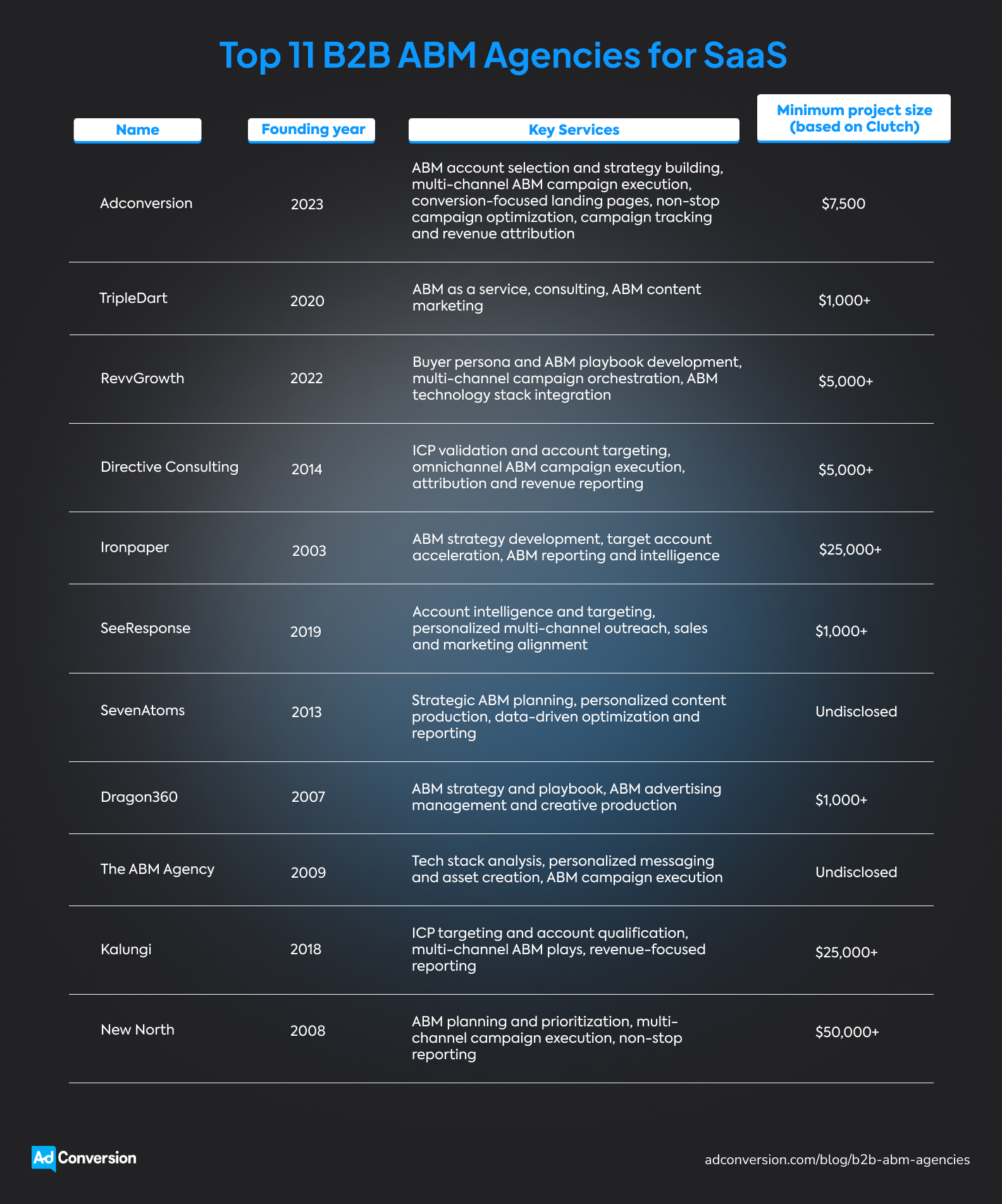
The hard part is figuring out which agency actually fits your business. So, take a closer look at their expertise, services, client feedback, results, and pricing to find the best match.
Disclosure: This article was created by AdConversion, a B2B ABM agency, and includes its own services. The blog post was last updated in June 2026 and reflects the author’s perspective, not an independent editorial review. The agencies were evaluated using public website info and reviews from Clutch, G2, Trustpilot, and HubSpot. The order is random and doesn’t represent a ranking system. AdConversion has no affiliate or commercial ties to the other agencies listed.
Table of Contents
What Are the Best B2B ABM Agencies for SaaS Startups?
What Are the Best ABM Agencies for B2B Saas Enterprises?
How Do You Choose a B2B ABM Agency?
1. AdConversion
AdConversion is a B2B SaaS growth partner focused on full-service paid media execution and hands-on training.
The company launched in 2023 under founder Silvio Perez and operates through three separate branches:
- AdConversion Academy is the educational side of the business. It offers free paid media courses, SaaS-specific playbooks, and community resources to upgrade your in-house team’s marketing skills. You can start with this beginner course on ABM essentials and go from there.
- Sami is AdConversion’s proprietary AI ad optimization sidekick that takes work off your plate. This tool can watch over your ads day and night and step in the moment spend starts rising and performance starts slipping.
- AdConversion Agency is the practitioner that gets things done for you. These pros build, run, and optimize your paid acquisition end-to-end to scale pipeline and revenue as soon as possible.
If you’re already spending on demand generation but struggle to engage the right decision-makers, AdConversion’s ABM Agency can turn things around for you.
AdConversion starts by zeroing in on the high-value accounts that best match your ideal buyer persona. It then uses multi-channel, personalized paid media to reach those accounts and push them towards sales calls and closed deals.
You’ll also work hand in hand with a dedicated senior performance marketer. This expert keeps a close eye on your ABM programs, spots and fixes issues early, and shares practical insights your sales team can use during outreach.
AdConversion has a proven ABM track record working with B2B SaaS brands like Checkr, Prelude, TeamOut, and ActiveCampaign.
Services:
Pros
Based on Clutch feedback and client testimonials:
- An event platform says AdConversion stays extremely proactive, showing up every week with fresh optimization ideas backed by real campaign data.
- A B2B SaaS client praises the agency for getting deeply involved in its marketing efforts and operating like an in-house growth team.
- The VP of growth marketing at NetSPI mentions that AdConversion produced on-brand ad creatives, freeing up time for the company’s internal marketing team.
Cons
Clutch reviews also point out the following:
- A community management platform notes that it took a bit of trial and error until the agency found the right direction for its paid acquisition.
- A B2B SaaS company recognizes that their data access restrictions held back AdConversion’s campaign audits for a while.
Case studies:
Minimum project size (Based on Clutch):
$7,500
Good to know: AdConversion uses a flat monthly pricing model and doesn’t take a percentage of your ad spend like most ABM agencies. The company also skips long-term commitments, so you can walk away after the first 30 days if you don’t see any measurable improvements.
2. TripleDart
TripleDart is a SaaS-focused B2B marketing agency specializing in pay-per-click (PPC), SEO, content, web design, and revenue operations (RevOps).
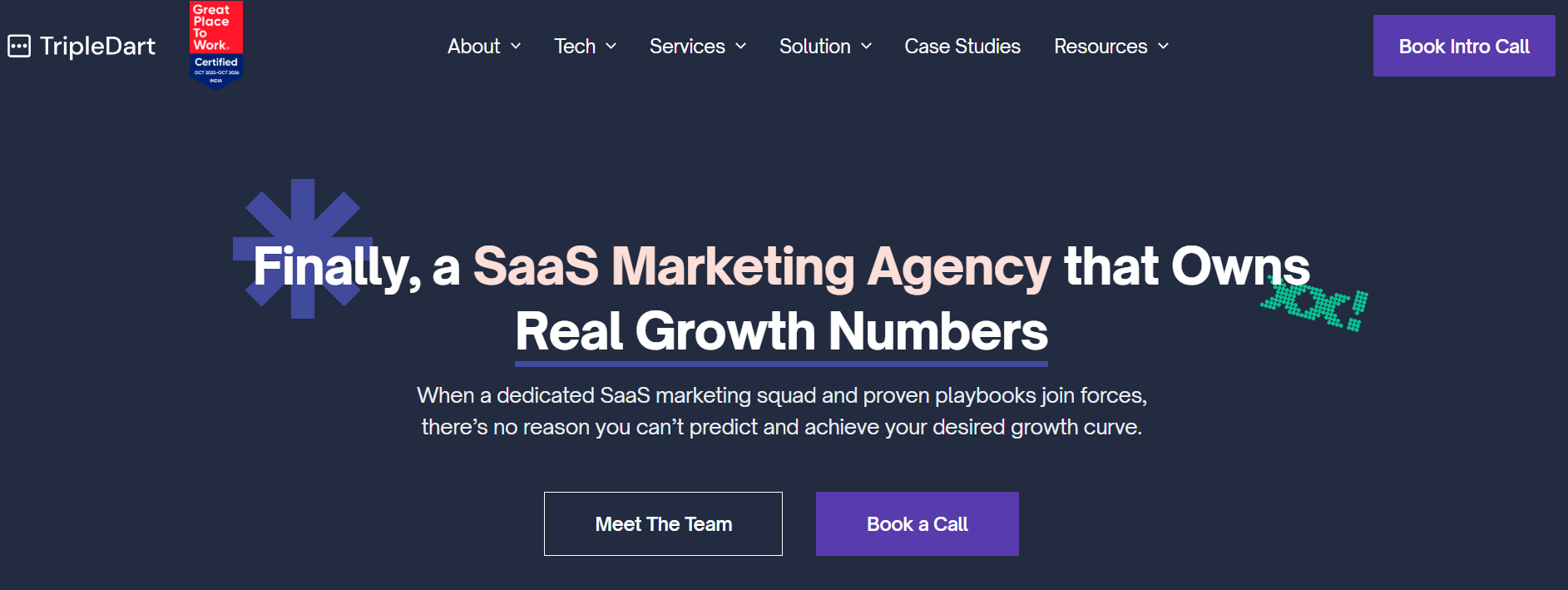
The agency was founded in 2020 and has an international client roster that includes names like Helpshift, Atlas HXM, and CleverTap.
TripleDart’s ABM agency works closely with your marketing and sales team to help them move faster with tighter targeting, personalized outreach, and practical execution.
Services:
Pros
Insights gathered from Trustpilot reviews show that:
- One client says TripleDart helped sharpen its ICP, segment target accounts more effectively, and create ABM messaging that felt much more connected to the sales process.
- A reviewer mentions that the agency really understands B2B SaaS, constantly brings fresh ideas to the table, and is easy to work with.
- Another user was especially impressed with the team’s creative work, which included professional motion graphics with user interface (UI) animations.
Cons
The only area for improvement found on Trustpilot is:
- A reviewer says quicker feedback loops and faster campaign updates would’ve made the collaboration even smoother.
Case studies:
Minimum project size (Based on Clutch):
$1,000+
3. RevvGrowth
RevvGrowth is an AI-driven marketing agency that helps SaaS brands win more sales opportunities through ABM, PPC, and search engine optimization (SEO).
Since its launch in 2022, the agency has partnered with B2B businesses such as Vymo, LeadSquared, and HyperVerge.
RevvGrowth has a dedicated ABM agency that combines AI-powered tools with human expertise to better understand how your buyers think before launching campaigns.
Services:
Pros
According to the only client review on Clutch, left by an information technology and services company:
- RevvGrowth was very proactive, helping the team execute campaigns faster and constantly pushing for real progress.
Cons
The same Clutch review notes that:
- To maximize value from your relationship with RevvGrowth, you must stay fully involved and work with them side by side.
Case studies:
Minimum project size (Based on Clutch):
$5,000+
4. Directive Consulting
Directive Consulting is a business-to-business agency founded in 2014 that offers a mix of performance, e-commerce, and communication marketing services.
The company works with B2B brands across many industries, including SaaS. TigerConnect, WordPress VIP, and ServiceChannel are just a few of its clients.
Directive Consulting builds full-funnel ABM programs around revenue impact. Its approach helps you prioritize high-fit accounts, shorten sales cycles, and spend your ad budget more efficiently.
Services:
Pros
Clutch reviewers frequently highlight:
- A data classification SaaS company says Directive Consulting is highly organized, always delivering work on time and going beyond the original scope to help the client’s internal team succeed.
- A tech agency praises Directive Consulting for being flexible and quickly adapting to its preferred workflows.
- A cloud platform company underlines the team’s deep marketing expertise and top-notch customer support.
Cons
Comments from Clutch suggest that:
- Directive Consulting might lack experience with certain back-end CRM and marketing automation setups, according to a business continuity company.
- A healthcare IT reseller mentions that the team sometimes moved too quickly through technical discussions, which made some weekly calls harder to follow.
- An HR software provider says onboarding took a long time before the campaigns were up and running.
Case studies:
Minimum project size (Based on Clutch):
$5,000+
5. Ironpaper
Ironpaper is a B2B growth agency that improves business results through ABM, lead generation, and sales enablement.
The agency has been around since 2003, working with diverse B2B companies, including SaaS brands like Lightning Step, Retarus, and Mobilewalla.
Ironpaper’s ABM agency puts a big focus on marketing and sales alignment to create more meaningful touchpoints that keep your enterprise accounts engaged.
Services:
Pros
Based on limited user experiences shared on G2:
- One client says Ironpaper helped fix weak spots in its sales funnel and suggested better content ideas to improve campaign performance.
- A reviewer praises the agency for taking the time to truly understand her business and taking over some of its internal tasks.
Cons
The same comments from G2 cite these limitations:
- A customer says the partnership had a slow start because an early consultant wasn’t the right match, but Ironpaper fixed the issue quickly.
- One reviewer notes that it can take some time to fully sync with the team’s working style, especially if you don’t set clear goals and expectations up front.
Case studies:
Minimum project size (Based on Clutch):
$25,000+
6. SeeResponse
SeeResponse is a B2B marketing agency launched in 2019 that prioritizes both inbound and outbound marketing.
The agency’s client base includes B2B SaaS brands like Ximplifi, Curacubby, and VWO.
SeeResponse’s main goal is to help your team identify the right account segments and execute personalized campaigns that make outreach more focused and effective.
Services:
Pros
Clutch reviewers praise the agency:
- A nonprofit organization says SeeResponse stayed on top of deadlines, communicated clearly, and kept the entire project moving without delays.
- An education technology company mentions that the team adjusted quickly to its changing messaging and target market, making collaboration much easier along the way.
- The agency helped an accounting company automate its marketing workflows, improve tracking, and bring in more leads and sales opportunities.
Cons
The only concerns shared on Clutch are:
- A medical device company says more long-term campaign planning check-ins would’ve helped align goals, expectations, and timelines better.
- An estate planning company mentions that spending more time up front on ICP discussions could’ve improved early targeting decisions.
- Onboarding took longer than expected for an IT company because target accounts and buyer personas were not clearly defined upfront.
Case studies:
Minimum project size (Based on Clutch):
$1,000+
7. SevenAtoms
SevenAtoms is a PPC-first marketing agency built for B2B brands looking to drive conversions and sales through paid advertising.
The agency started out in 2013 and mainly works with B2B companies in SaaS, technology, healthcare, and e-commerce. SISU Data, Pro-Vigil, and Red River are among its clientele.
SevenAtoms takes a buyer-focused approach to ABM. Its messaging, campaigns, and content are all tailored to the specific concerns and decision-making process of each account you want to win.
Services:
Pros
Clients on Clutch underline that:
- A commerce platform says SevenAtoms always delivered on time, was highly responsive, and went beyond what was originally expected.
- A cloud application platform praises the agency’s reporting process, which breaks down what’s performing well and where campaigns need improvement.
- SevenAtoms is honest about its capabilities and focuses on the services it’s really good at, according to a motor vehicle parts distributor.
Cons
The only improvement area found on Clutch is:
- The same cloud application platform would like SevenAtoms to validate and test new PPC ideas before applying them to live campaigns.
Case studies:
Minimum project size (Based on Clutch):
Undisclosed
8. Dragon360
Dragon360 is a digital marketing agency that turns ABM campaigns into B2B sales using paid advertising, strategy, and creative.
Since 2007, the agency has partnered with many SaaS brands, including Planet DDS, Simon Data, and Tungsten Automation.
Dragon360 treats ABM like a coordinated growth system by connecting segmentation, messaging, B2B advertising, and measurement to your high-value accounts.
Services:
Pros
Feedback trends from Clutch:
- A labeling solutions company says Dragon360 pairs deep marketing expertise with efficient communication, making them easy to work with at every level of the business.
- The agency delivered high-quality work on time and earned enough trust to run campaigns with minimal oversight for one software company.
- A life insurance company notes that the team understood its business needs quickly and brought smart ideas that helped move growth forward.
Cons
Clutch users have flagged the following:
- A technology company would’ve liked more visibility into Dragon360’s day-to-day campaign optimization work and recommends handling strategic planning internally before kickoff.
- An engineering software company mentions that early meetings could’ve been more structured, although the team improved quickly.
Case studies:
Minimum project size (Based on Clutch):
$1,000+
9. The ABM Agency
The ABM Agency is a B2B marketing agency built entirely around account-based marketing.
The company has collaborated with top B2B SaaS brands like IBM, Cloudflare, and SentiLink since its launch in 2009.
The ABM Agency creates highly personalized 1:1 and 1:Few ABM campaigns to help you stay relevant and influence large buying committees more effectively.
Services:
Pros
Noted in G2 reviews:
- One client says The ABM Agency puts serious effort into researching strategic accounts and mapping buying roles, and stays involved throughout execution.
- A customer mentions the agency’s tech stack review is very detailed and appreciated that they focused on getting more value from existing tools rather than pushing extra software.
- Another reviewer notes the team was approachable, supportive, and easy to work with, and organized frequent meetings to keep them in the loop.
Cons
The only trade-offs shared on G2 are:
- Some of The ABM Agency’s recommendations required bigger internal workflow changes, which slowed down implementation for one client.
- One reviewer would’ve liked a shorter discovery and planning phase with less stakeholder involvement.
- A customer mentions that the agency’s campaigns take months to build, launch, and show results, so you shouldn’t expect quick wins.
Case studies:
The agency has only two ABM case studies on its website, but doesn’t give any client names.
Minimum project size (Based on Clutch):
Undisclosed
10. Kalungi
Kalungi is a B2B SaaS marketing agency that grows your pipeline through ABM, positioning, and go-to-market strategies.
The agency has been on the market since 2018, supporting B2B SaaS brands like Patch, PSignite, and Aware360.
Kalungi’s top priority is to help your team stop chasing weak-fit leads and start engaging accounts that actually have revenue potential.
Services:
Pros
A few strengths found in HubSpot reviews include:
- One reviewer says Kalungi did a great job bringing sales, marketing, and outside partners together, building a strong growth foundation.
- A client praises the agency for adapting onboarding to fit the company’s setup and staying flexible with teams spread across different time zones.
- Another customer mentions that the team opened up new paid acquisition channels without requiring much internal involvement.
Cons
Even though HubSpot reviewers don’t cite any limitations, it’s worth noting that:
- Companies looking for a wider mix of ABM channels should ask more questions up front, since Kalungi’s website only covers ABM run on LinkedIn, email, and landing pages.
Case studies:
Minimum project size (Based on Clutch):
$25,000+
11. New North
New North is a B2B marketing agency that helps you hit your growth goals using effective ABM tactics, paid advertising, and content.
The agency launched back in 2008 and has since worked with B2B tech companies like Hydrian, Qu, and Swipesum.
New North operates on a hands-on execution model. The team manages your marketing campaigns from start to finish and gives you full visibility into their process.
Services:
Pros
From what users mention in Clutch reviews:
- A financial consulting firm says New North learned its industry surprisingly fast, adapted campaigns to fit the business, and kept coming up with new ideas throughout the engagement.
- An enterprise software company mentions that the agency kept it in the loop at all times, sharing regular updates and practical recommendations on what to do next.
- A veterinary business praises the team for understanding its niche market and producing relevant content that actually resonated with its audience.
Cons
Reviewers on Clutch also have this to say:
- An air purifier manufacturer says the agency’s graphic design work needed more back-and-forth than expected.
- A consulting group would’ve liked to see faster campaign progress, but the final results made up for it.
- The team could focus more on turning campaign engagement into qualified leads instead of mainly increasing visibility and traffic, according to an IT support company.
Case studies:
New North’s website features only one ABM case study for a B2B inventory optimization company.
Minimum project size (Based on Clutch):
$50,000+
What Are the Best B2B ABM Agencies for SaaS Startups?
The best B2B ABM agencies for SaaS startups help you engage sales-ready leads quickly without burning through your marketing budget or stretching your small team too thin.
- AdConversion specializes in bringing in sales opportunities without wasting money for seed-stage and Series A+ B2B SaaS startups. The agency builds full-funnel ABM campaigns around customer acquisition cost and lifetime value efficiency, and helps your brand earn credibility through personalized paid media.
- TripleDart helps early-stage B2B SaaS companies tighten their ICP targeting, build marketing infrastructure, and create predictable acquisition systems without hiring a full in-house growth team.
- New North keeps things practical and execution-focused, helping growing B2B SaaS companies launch campaigns quickly, enter new markets, and stay closely involved in day-to-day performance.
What Are the Best B2B ABM Agencies for SaaS Enterprises?
The best ABM agencies for B2B SaaS enterprises know how to influence large accounts, manage longer sales cycles, and tie ABM campaigns to revenue outcomes.
- AdConversion helps enterprise SaaS companies reach full buying committees, from executives and champions to evaluators and influencers. The agency runs multi-touch ABM campaigns across paid search and paid social and tailors messaging to each stakeholder group. It also manages large ad budgets (around $150K/month) comfortably, always targeting and reporting on key revenue metrics.
- The ABM Agency is specifically designed for Fortune 500 enterprises that need 1:1 and 1:few ABM programs built around global buying committees and high-stakes sales cycles.
- SeeResponse keeps enterprise sales and marketing tightly connected through coordinated outreach, account segmentation, and personalized messaging.
How Do You Choose a B2B ABM Agency?
Choose a B2B ABM agency that understands your market, matches your growth stage, and proves that it can deliver measurable results.
Step 1: Make sure the agency understands your market
A SaaS startup selling to mid-market teams has very different challenges than an enterprise company selling into global accounts.
You want an agency that already understands your industry, sales cycles, and the kind of buyers you’re trying to reach.
This expertise usually leads to better messaging, smarter targeting, and faster execution.
Step 2: Check the services included
Some agencies only give you strategy and leave the heavy lifting to your internal team. Others actually run paid media, create content, optimize landing pages, and handle reporting.
Before signing anything, make sure the agency covers the areas where your team needs the most help.
You should also know that companies that combine ABM with account-based advertising see win rates nearly 60% higher, according to AdRoll findings.
Step 3: Read case studies carefully
Good ABM agencies talk about pipeline and revenue, not just clicks and impressions.
Pay close attention to case studies that mention SQLs, ROAS, conversion rates, and closed deals. Those numbers tell you a lot about the agency’s skills and impact.
Step 4: Look beyond star ratings in reviews
Client reviews can reveal things agency websites never mention. Look for feedback about communication, responsiveness, reporting quality, and how involved the team stays after campaigns launch.
You want a partner that keeps improving campaigns instead of going quiet once onboarding ends.
Step 5: Ask detailed questions about pricing
ABM pricing can vary a lot between agencies. Some charge flat retainers, while others charge extra fees for ad spend, creative production, or multiple channels.
Ask for a detailed breakdown up front so you know exactly where your budget is going before the engagement starts.
Final Thoughts on Finding the Right Partner for Your ABM Strategy
ABM is a must-have for companies that want to close larger deals and shorten sales cycles and you need an experienced partner to make it work.
Choose a B2B ABM agency that helps your team move faster, make smarter decisions, and create more meaningful conversations with the accounts that matter most.
If you want to see how account-based advertising looks in practice, have a quick chat with AdConversion.
10 Best B2B Demand Gen Agencies Scaling Revenue in 2026
B2B demand generation agencies are marketing experts that get your brand in front of the right people, spark interest, and turn that attention into sales conversations.
They use tactics like paid media, SEO, content, or outreach and track results to show you what's working.
Some of the top demand generation agencies for B2B are:
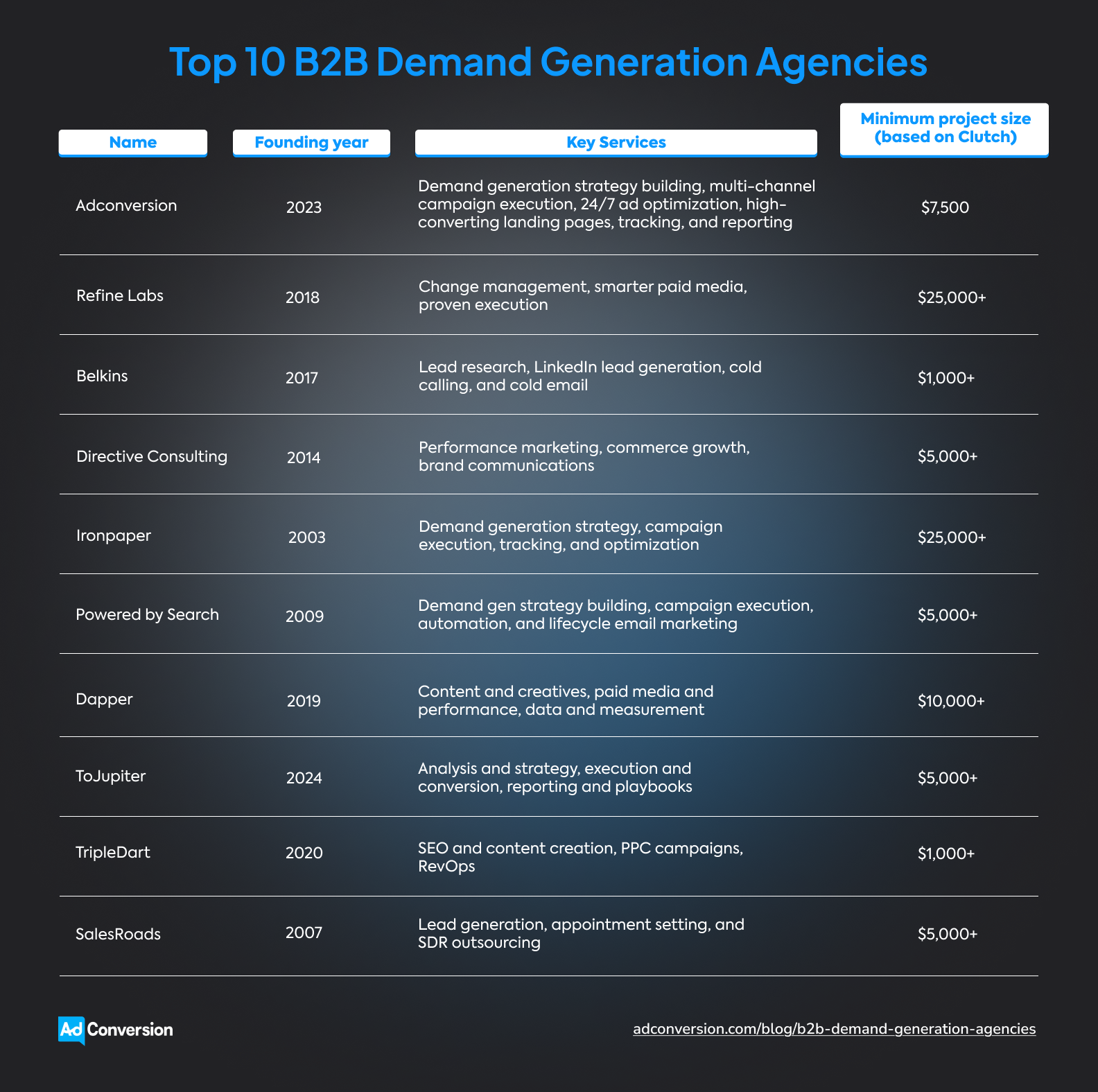
The tricky part is picking the right agency. Go with a team that truly understands your market, delivers real revenue impact, and knows how to generate sales-ready leads.
Disclosure: This article was created by AdConversion, a B2B demand generation agency, and includes its own services. The blog post was last updated in May 2026 and reflects the author’s perspective, not an independent editorial review. The agencies were evaluated using public website info and reviews from Clutch, G2, Trustpilot, and HubSpot. The order is random and doesn’t represent a ranking system. AdConversion has no affiliate or commercial ties to the other agencies listed.
Table of Contents
What Are the Top B2B Demand Generation Agencies for SaaS?
What Are the Best B2B Demand Generation Agencies for Startups?
What Are the Top B2B Demand Generation Agencies for Enterprises?
How Do You Choose a B2B Demand Generation Agency?
1. AdConversion
AdConversion is a B2B growth agency built for SaaS companies that want paid media to create real pipeline and revenue.
Silvio Perez launched the company in 2023, aiming to combine agency execution with hands-on education. Thanks to this unique approach, you now have two options:
- Train your in-house team for free, through AdConversion Academy, to step up your paid acquisition game. The beginner course to building a paid media program is an excellent starting point.
- Hand over the execution to the AdConversion Agency and let it run your ad campaigns end-to-end, from strategy and creatives all the way to tracking and reporting.
The AdConversion Demand Generation Agency works with B2B SaaS companies that keep investing in paid media but have little to show for it.
Some teams are generating leads that never turn into sales opportunities, while others are burning through their budgets with no change in lead volume.
AdConversion steps in to fix the problems causing all that waste. The company audits your current setup, finds what’s hurting performance, and rebuilds your paid media program around demand generation.
The best part is that AdConversion targets revenue metrics that help you grow. These include cost per sales-qualified lead (SQL), customer acquisition cost (CAC), return on ad spend (ROAS), closed revenue, and more.
You’ll also be assigned your very own senior strategist who knows everything about your account and can make quick decisions and changes without waiting for approvals.
Rippling, ActiveCampaign, Checkr, DigitalOcean, and Warmly are just a few clients who stand as proof that AdConversion can help your paid advertising turn the corner.
Services:
Pros:
Client reviews and portfolio testimonials point to a few standout strengths:
- AdConversion drives more sales opportunities, reduces your cost per marketing-qualified lead (MQL), and improves ROAS, while keeping an eye on revenue.
- The agency is always one step ahead, closely monitoring ad performance, spotting problems early, and pushing new ideas to achieve better results.
- Campaigns move quickly because ad creatives are produced in-house, leading to fewer delays, faster launches, and greater brand consistency.
Cons:
Feedback from Clutch shows that:
- AdConversion needs reliable CRM data to do its best work, so messy setups can delay progress.
- Not every experiment is a success, so you might see short-term dips while the agency tests new ideas.
Case studies:
Minimum project size (based on Clutch):
$7,500
Good to know: AdConversion uses a flat monthly pricing model instead of chasing percentages of your ad spend. So, even if you decide to invest more in ads, you’ll pay the same management fee.
2. Refine Labs
Refine Labs is a B2B demand gen agency that replaces old-school lead generation with modern growth strategies.
Founded in 2018, the agency partners with B2B SaaS brands like myCOI, Splash, and Loxo.
Refine Labs works closely with your internal teams, pushing them to stop chasing form-fills and start building awareness, capturing intent, and expanding revenue from the right accounts.
Services:
Pros:
Based on limited G2 reviews:
- Refine Labs offers deep market research and advanced strategy skills, giving your team a smarter path to growth.
- The agency helps you reach new audiences and buyer groups that your previous marketing efforts missed.
- The company’s brand strategies continue to generate awareness and return on investment (ROI) even months after the initial setup.
Cons:
The only downside mentioned on G2 is:
- Since brand awareness is not always easy to measure, it can take time to see positive results.
Case studies:
Minimum project size (based on Clutch):
$25,000+
3. Belkins
Belkins is a B2B lead generation agency launched in 2017 that helps companies book more sales meetings through outbound outreach and appointment setting.
The agency specializes in over 50 industries, including SaaS, healthcare, manufacturing, and financial services. Maark, Disability Solutions, and Fire Safety and Protection (FSP) are some of its clients.
While other agencies focus on paid media or inbound marketing, Belkins operates on an outbound-first model, helping you start conversations directly with decision-makers.
Services:
Pros:
Reviews from Clutch show that:
- Belkins can book you a healthy number of relevant meetings and increase your email open and reply rates.
- The agency hits outreach goals quickly and leaves you with a high-quality prospect database for future campaigns.
- The team takes the time to learn your product in detail and can even refine your ideal B2B buyer persona.
Cons:
Some client reviews point out that:
- Better integration with the clients’ sales systems could make day-to-day work easier.
- The agency could offer more strategic input early on to improve lead quality from the first campaigns.
- Email templates can take longer than expected to get right, and you need to be involved.
Case studies:
Minimum project size (based on Clutch):
$1,000+
4. Directive Consulting
Directive Consulting is a B2B marketing agency that transforms buying intent into sales opportunities.
The agency started in 2014 and has a proven track record of working with technology and service brands such as Skillable, Arctic Wolf, and WordPress VIP.
What sets Directive Consulting apart is its focus on meeting potential buyers the moment they start researching solutions, comparing vendors, and getting ready to talk to sales.
Services:
Pros:
Directive Consulting clients appreciate that:
- The agency knows the B2B SaaS space well and provides useful benchmark data to help you make better marketing decisions.
- The team pushes your budget where it can create the best return, based on CAC, lifetime value (LTV), and ROI.
- The agency improves your traffic quality and lowers acquisition costs through a mix of SEO and pay-per-click (PPC).
Cons:
Some of the downsides Clutch reviewers mention are:
- Directive Consulting is a better fit for companies looking for performance marketing rather than a broad, full-service partner.
- Keeping up with the agency’s volume of reporting and recommendations can be hard.
- Since the agency doesn’t offer marketing automation, you might need another partner to help out with lead nurturing and conversion workflows.
Case studies:
Minimum project size (based on Clutch):
$5,000+
5. Ironpaper
Ironpaper is a B2B growth agency built for companies that need marketing to drive high-quality opportunities and sales.
Since 2003, the agency has partnered with B2B companies in technology, manufacturing, healthcare, and energy that have complex sales cycles. Ambi Robotics, Mobilewalla, and Lightning Step are part of its client roster.
Ironpaper treats marketing and sales processes as a single growth system, judging every campaign by the number of qualified leads, target account engagement, and real opportunities created.
Services:
Pros:
Limited G2 reviews show that:
- Ironpaper dives deep into your sales funnel, showing what’s working, what’s hurting results, and how to improve.
- The agency delivers quick lead gen wins while also putting a longer-term growth plan in place.
Cons:
Reviewers also cite a couple of limitations:
- It can take some time to get in sync with the agency before the partnership starts working smoothly.
- Your first assigned account manager might not always be the right fit, but Ironpaper is quick to reassign when needed.
Case studies:
Minimum project size (based on Clutch):
$25,000+
6. Powered by Search
Powered by Search is a B2B marketing agency that helps clients break out of slow growth and start seeing more demos, trials, and sales opportunities.
The agency has been around since 2009, working with B2B software and technology companies in finance, healthcare, legal, and cloud. Its client list includes brands like Cyera, iWave, and Fortra.
Powered by Search fixes your entire funnel, bringing in the right traffic and turning it into real interest.
Services:
Pros:
Based on the only client review available on HubSpot:
- Powered by Search can get your desired keyword to the number one position on Google, attract qualified leads, and increase conversions in 90 days.
Cons:
A potential downside might be:
- Since the agency works best when it integrates closely with your team, you’ll probably need to stay involved every step of the way.
Case studies:
Minimum project size (based on Clutch):
$5,000+
7. Dapper
Dapper is a B2B demand gen agency that keeps brands on the ideal customer’s radar until they’re ready to buy.
Launched in 2019, the agency targets B2B SaaS, service, and hardware businesses. Its list of happy customers includes Online Payment Platform, Bluebird, and FOCUS-ON.
Dapper is best-known for its ‘niche-famous’ approach. The agency makes sure your target accounts keep seeing your brand, so when the buying moment comes, yours is the first name that pops into their heads.
Services:
Pros:
Clutch feedback highlights that:
- Dapper’s paid and organic campaigns can double your customer base and social community.
- The agency offers detailed analytics that help you understand engagement better and move prospects further down the funnel.
- The team responds quickly, sends you regular updates, and keeps projects on track.
Cons:
A few trade-offs found in client reviews include:
- The project management tools can be a bit overwhelming, especially if you prefer a simpler way to track progress.
- Changes in the account team can sometimes disrupt continuity.
- It can take a bit of time for the team to fully align creatives with your brand guidelines.
Case studies:
Minimum project size (based on Clutch):
$10,000+
8. ToJupiter
ToJupiter is a B2B demand generation agency founded in 2024 that plugs into your GTM team to help you focus on what actually brings in revenue.
The agency partners with fast-growing SaaS startups like Goldcast, Brevo, and Level that want to create a predictable growth engine.
ToJupiter has two goals: speed and accountability. Its team quickly finds what drives results, prioritizes winning channels, and helps you create, capture, and convert demand into real deals.
Services:
Pros:
Customer reviews indicate that:
- ToJupiter can quickly boost MQLs, improve alignment with target accounts, and help you book more qualified meetings.
- The agency knows paid media well and moves fast, getting campaigns live without missing key details.
- The team is proactive and flexible, adjusting quickly when plans change.
Cons:
Reviewers also note a few downsides:
- Things can feel a bit hectic at first, with a lot of back-and-forth before everything settles into place.
- Your team needs to keep up with the agency’s fast pace, which can be difficult at times.
Case studies:
ToJupiter doesn’t have any published case studies, but its customer testimonials show it to be the real deal:
- Intechnica: 563% increase in marketing-sourced deals
- Lunio: 250% year-on-year growth driven by marketing
- Netacea: 80% total pipeline contribution from marketing
Minimum project size (based on Clutch):
$5,000+
9. TripleDart
TripleDart is a B2B SaaS marketing agency designed to turn traffic into pipeline and pipeline into revenue.
The agency started in 2020 and has clients across 12 countries, including brands such as CleverTap, Signeasy, and Airbase.
TripleDart quickly audits your programs, sets 30-, 60-, and 90-day targets, and works side by side with your team to double down on the channels that deliver predictable results.
Services:
Pros:
From what users mention in Trustpilot reviews:
- TripleDart‘s reporting is easy to follow, showing you what’s changing in your campaigns and what’s producing results.
- The team delivers ad creatives that fit your brand and speak to the right buyers.
- Communication runs smoothly, even when working across different time zones.
Cons:
Agency clients also call attention to:
- During active testing, updates and campaign changes may take a bit longer than expected.
- The agency might work best for teams still building their paid media foundation rather than those managing more advanced setups.
Case studies:
Minimum project size (based on Clutch):
$1,000+
10. SalesRoads
SalesRoads is a B2B sales outsourcing agency founded in 2007 that fills your calendar with qualified sales conversations.
The agency targets B2B brands in multiple industries, including SaaS, manufacturing, and healthcare. Its client base includes companies like AchieveIt, Parker Hannifin, and Factor Architecture & Engineering.
What makes SalesRoads different is its outbound-first approach to demand creation. The agency uses trained sales reps to handle prospecting, outreach, and qualification, so your sales team can focus only on closing deals.
Services:
Pros:
Several clients mention these strengths:
- SalesRoads turns more calls into qualified follow-ups and can help you exceed your ROI targets.
- The agency puts in the work to understand your ICP and keeps refining the approach to get better results over time.
- The team delivers items on time, adapts quickly, and offers helpful input to keep campaigns moving.
Cons:
Reviewers report a few challenges:
- Your sales team needs to stay involved and give regular feedback, or results might not meet expectations.
- Email outreach could be used more effectively as part of the overall strategy.
Case studies:
Minimum project size (based on Clutch):
$5,000+
What Are the Top B2B Demand Generation Agencies for SaaS?
Top B2B demand generation agencies for SaaS understand product-led growth, long sales cycles, and how to convert demand into deals:
- AdConversion builds and executes SaaS paid media campaigns that target each stage of the buyer journey to drive more sales opportunities and tie every campaign back to CRM revenue.
- Refine Labs helps SaaS teams build demand early, improve messaging, and align marketing efforts with how buyers actually research and choose products.
- TripleDart is a good solution for SaaS brands that want to increase their online visibility quickly and fix CRM and funnel gaps to turn more traffic into qualified opportunities.
What Are the Best B2B Demand Generation Agencies for Startups?
The best B2B demand generation agencies for startups move quickly, test channels without wasting budget, and turn early traction into customer acquisition:
- AdConversion serves Series A+ startups struggling with inefficient, high-cost paid ads. The agency experiments with different ad platforms and creatives to reach the right buyers quickly and cut wasted ad spend.
- Powered by Search helps startups attract sales-ready leads and convert them into demos and trials quickly, using paid media, SEO, and content.
- ToJupiter fits startups that want hands-on support, acting like part of the team to launch campaigns fast, test ideas, and align closely with sales to turn interest into real deals.
What Are the Top B2B Demand Generation Agencies for Enterprises?
Top B2B demand generation agencies for enterprises know how to handle complex sales cycles, large budgets, and multiple stakeholders while keeping everything revenue-focused:
- AdConversion runs enterprise-level programs using effective ABM tactics across paid search and social, and regularly handles $150K/month ad budgets. The agency also tracks how every touchpoint turns into revenue, giving you full visibility into every campaign.
- Belkins uses research, outreach, and appointment setting to connect enterprises with the right decision-makers and keep sales teams focused on closing.
- Ironpaper manages enterprise ABM campaigns that engage key accounts, align marketing and sales, and push buyers toward a purchase.
How Do You Choose a B2B Demand Generation Agency?
Choose a B2B demand generation agency that understands your growth model and knows how to generate real demand and revenue.
Always keep an eye on these criteria:
- Specialization: Look for an agency that already works with B2B companies like yours and knows how your sales cycles and buying journey actually work, so you can see results faster.
- Services: Make sure the agency covers the channels and tactics you need, whether that’s paid search or YouTube ads, content marketing, ABM, or lifecycle campaigns. Gartner’s 2025 CMO Spend Survey shows that paid media remains the front runner, accounting for 30.6% of B2B marketing budgets.
- Results: Search for case studies tied to SQLs, conversion rates, and revenue growth that prove that the agency can deliver on its promises.
- Reviews: Check client feedback on platforms like Clutch, G2, and Trustpilot to see how the agency communicates, adapts, and performs over time.
- Pricing: Choose a pricing model that fits your stage and budget, and make sure you understand exactly what you’re paying for before you commit.
Final Thoughts: Choosing the Right Partner for Your Demand Gen Strategy
At the end of the day, picking a B2B demand generation agency means finding a partner that gets how your buyers think and can turn attention into opportunities and sales.
Some agencies focus on sales outreach, while others are centered around paid media, content, or SEO. The best choice depends on what’s holding your growth back right now.
If you want to increase demand from your ad spend, have a quick chat with AdConversion to see if it makes sense for you.
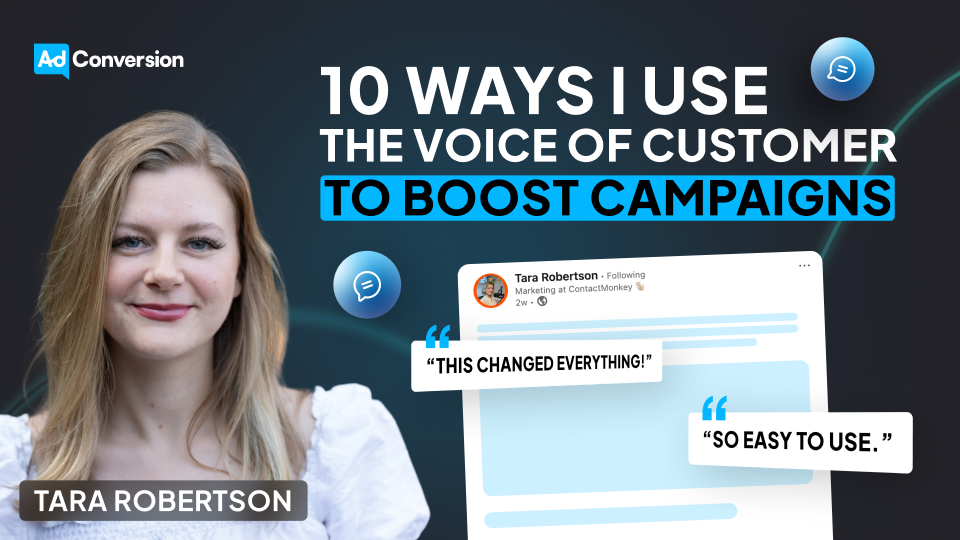
10 Voice of Customer Marketing Tips to Create High-Converting Campaigns

If I had to boil down my entire job as a marketer into one sentence, it’d be this: I listen to customers and then build campaigns that sound like them.
Voice of customer (VOC) isn’t just a tactic. It’s the strategy. It’s the thing AI can’t fake, dashboards can’t predict, and competitors can’t steal. It’s also where all my best ideas come from.
Here are 10 detailed ways I collect, activate, and scale the voice of a customer across everything I do.
1. Start every new role by talking to customers. Relentlessly.
When I joined ContactMonkey, the very first thing I did wasn’t digging into attribution models or revamping landing pages. It was scheduling as many customer and prospect conversations as I could fit into my calendar.
I even made it part of my official 30-60-90 plan.
In those early weeks when your brain is still fresh and your to-do list is short, there’s nothing more valuable than hearing firsthand what people love, hate, and don’t understand about your product or category.
One of my favorite moves?
Posting on LinkedIn asking if anyone in my network is willing to get on a quick call. In this case, I posted asking if anyone in my network owns internal comms and would be willing to chat (our ICP at ContactMonkey).
I offered to buy them a coffee in exchange for a chat (no sales pitch).
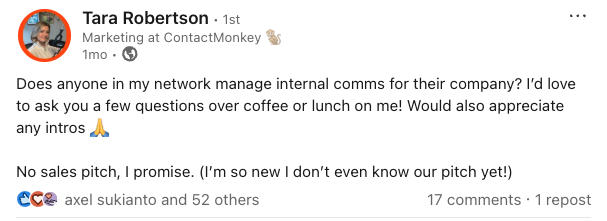
I got 12+ responses. If you don’t have a network in your space yet, no problem.
Shadow your CS or AM teams. Listen to support calls. It’s not about volume, it’s about patterns.
When I start hearing the same pain points and language again and again, that’s when I know I’ve struck gold.
2. Replace vague promises with oddly specific customer results
Years ago at Chili Piper, we ran one of our most successful landing page tests using a stat pulled directly from a customer.
The control copy said “Double your meetings”. A nice round promise. The variation said “Book 48% more meetings”. Not as flashy, but 100% real results from a real customer.
And it crushed. Why?
Because people can smell BS. “Double” sounds too good to be true.
But “48%” feels like someone actually ran the numbers. The same logic applied to our newsletter sign-up. We swapped “Join 15k+ marketers” for the actual number, like “14,889 marketers”, and updated it monthly. Way better engagement.
I’ve learned that authenticity beats hyperbole every single time.
Whether it’s landing pages, ads, or CTAs, I always ask: can I anchor this in a real result? If I can, that’s the copy I go with.
3. Scale testimonial collection
Most marketers want more testimonials. But very few make it easy for customers to give them.
That’s where tools like testimonial.io come in. At Chili Piper, we used it to collect both video and text testimonials at scale.
What I loved is that it wasn’t just a form. It created a nice-looking landing page where we could showcase quotes, filter by industry or persona, and make it dead simple for sales to grab proof on demand.
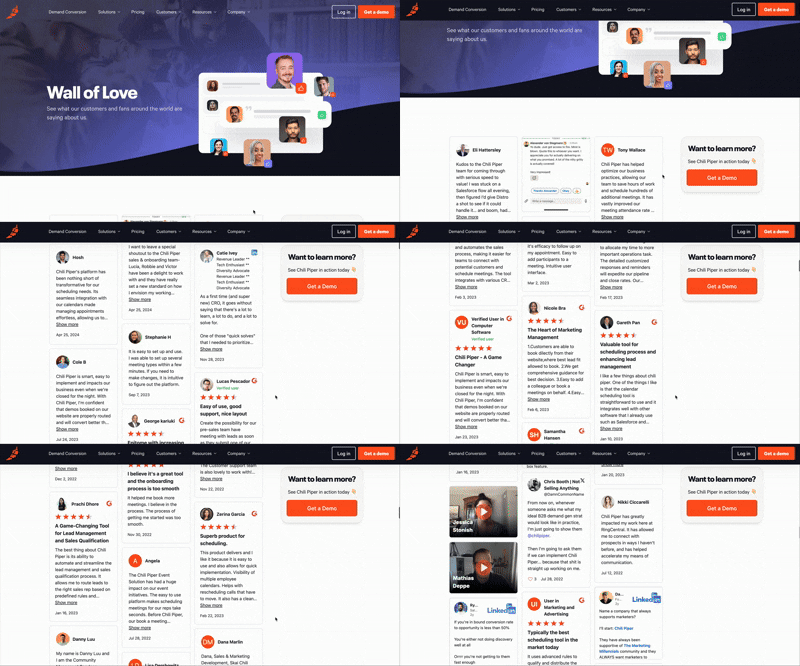
We even layered in rewards: For example, $10 for a written review, $20 for a video.
It made the process feel fun, not transactional. If you don’t have the budget for a tool, you can still make this work with forms and folders. It just requires more manual work.
But either way, the key is removing friction. Make it easy, incentivize smartly, and watch the social proof roll in.
4. Map the moments when asking for testimonials feels natural
I used to be hesitant about asking happy customers for quotes or reviews. It felt too much like asking someone who’s already paying us for more favors.
Now I’ve learned that timing is everything and when you get it right, people are actually eager to help.
At Chili Piper (and coming soon to ContactMonkey!), we built simple workflows around high-NPS scores.
If someone gave us a 9 or 10, they’d get an email asking if they’d share a quick testimonial (with an incentive if we needed it).
Renewal time is another great moment. If the CSM is having a positive QBR, that’s your window.
And if you have an in-app experience, even better. Prompt people when they’ve just hit a milestone or seen a big win.
These are the moments when they’re feeling the value and that’s when you should make the ask. Not months later in a generic email blast.
5. Mine sales calls using Gong alerts
If your sales team uses Gong, Clari, or any call recording tool, you’re sitting on a goldmine of unfiltered customer language.
At Chili Piper, I set up custom alerts for keywords like “love this,” “so helpful,” or “amazing”.
Whenever a prospect or customer said something positive, I’d get an alert. Sometimes we’d clip those and turn them into ads. Other times we’d just use them for internal messaging work.
At ContactMonkey, I’ve taken it further. I created an alert for the word “chaos” because we were testing a new homepage copy around that theme.
Now I can see in real time if that word is spiking in conversations. It’s like a heartbeat monitor for customer sentiment.
Pro tip: Make sure your alerts only track customer speech, not your reps. Otherwise, you’ll get a lot of noise. This is one of the lowest-lift, highest-impact VOC tactics I’ve ever used.
6. I always prioritize real photos over polished stock
In one of my previous companies, we ran a bunch of Facebook ads targeting college professors. We tested beautifully lit, high-production images.
We even went to a local university campus and took our own photos.
But the creative that won?
A grainy, dimly lit shot of a real professor with a projector half-illuminating his face. It looked like a scene from a low-budget documentary and it worked like magic.
Why?
Because it was instantly recognizable to our audience. They saw themselves in that ad. That lesson stuck with me.
I now prioritize real customer images (with permission, of course) over generic visuals, especially on social platforms like LinkedIn.
Even if the photo isn’t perfect, the context is. It builds trust faster than any stock model with a laptop ever could.
7. Engineer VOC moments at in-person events
One of the most underrated ways to capture and activate the voice of a customer is through small, curated in-person dinners.
At Chili Piper, we’d pick anchor events, like INBOUND or SaaStr, and then build a dinner party around them. We invited a mix of customers and high-fit prospects. No pitch. Just dinner.
But the magic was in the seating chart.
When a prospect ends up next to a customer, the VOC starts flowing naturally. It’s not a case study. It’s a conversation. And it’s way more persuasive than sitting them beside someone from your sales team.
These dinners don’t have to break the bank. We’d partner with other Martech brands targeting the same ICP, split the cost, and divide the invite list. We typically budgeted around $200 per head depending on the city (this can vary wildly).
But if you can’t swing a dinner? Start by gifting tickets to customers so they can attend the event. That alone builds goodwill and puts your brand top of mind.
8. Create memorable, feel-good moments for customers
One of my favorite VOC plays was when we ran a billboard that was not about us, but celebrating our customers.
People took selfies with it. It created a moment.
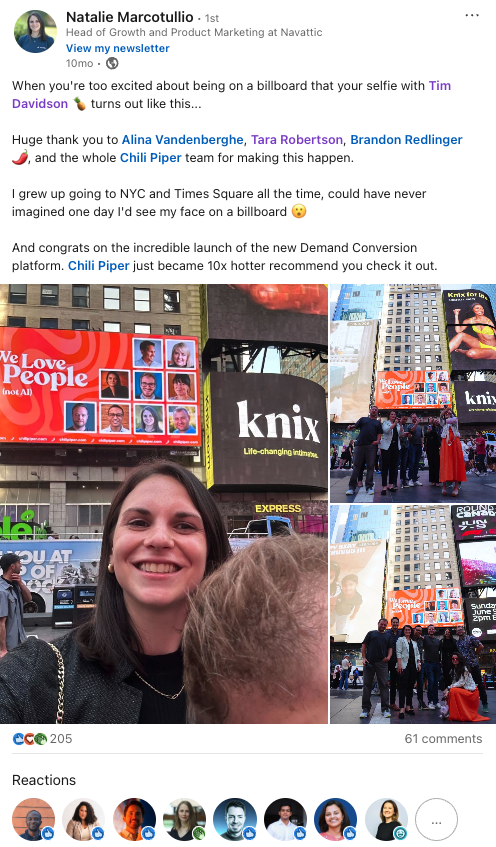
You can apply the same principle with award nominations, speaking opportunities, or simply amplifying your customers’ successes.
These aren’t transactional gestures. I don’t do them expecting a quote or post in return. I do them because they’re the right thing to do.
People remember how you made them feel. When you make your customers feel seen and valued, they’re more likely to become your advocates.
Reciprocity is real but only when it’s authentic. Whether it’s putting them on stage, giving them swag, or celebrating their wins, this kind of VOC is quiet but powerful.
9. Recycle everything into retargeting gold
Once you start collecting VOC, don’t let it sit in Notion or your testimonial page. Use it. In your retargeting campaigns especially.
At Chili Piper we ran video snippets from customer calls as YouTube pre-roll. We sliced a single testimonial video into six different LinkedIn ads. We even ran static image ads that are just screenshots of nice LinkedIn posts or tweets.
If someone says something amazing about you on LinkedIn, screenshot it and run it as an ad. That’s what I used to do before Thought Leader ads were even a thing.
Don’t worry about fancy production. Don’t wait until you have a full video library. Start with what you have.
Voice of the customer doesn’t always need tons of polish. It needs visibility.
10. Amplify customers with Thought Leader ads (yes, from their accounts)
This one is super meta, but wildly effective.
If a customer writes a post about your event, product, or company, don’t just repost it from your brand page.
With LinkedIn’s Thought Leader ad type, you can run their post as an ad from their account. It’s voice of customer, directly from the customer’s mouth.
Chili Piper is doing this with people who attended their ChiliPalooza event. They encouraged them to post their takeaways, then promoted those posts with paid. I haven’t tested it yet at ContactMonkey, but it’s high on my list.
It’s a modern version of influencer marketing, except the influencer is your actual user. Just make sure they’re comfortable with it, and always get consent.
Bonus: If you can’t run it as an ad, screenshot it and use it in your retargeting. It still works.
The voice of the customer isn’t a box I check. It’s the lens I try to apply to everything I do, from homepage headlines to how I design event experiences.
Because at the end of the day, no copy I write will ever be more compelling than something a real customer says when they don’t know they’re being marketed to.
That’s the voice that cuts through the noise.
Hope you found this article helpful!
If you’re looking to pick up an advertising course, check out these free courses that will teach you how to launch, optimize, and scale ad campaigns effectively.
And if you have any questions about using the voice of the customer in your campaigns, feel free to send me a message on LinkedIn, I love connecting with fellow marketers!
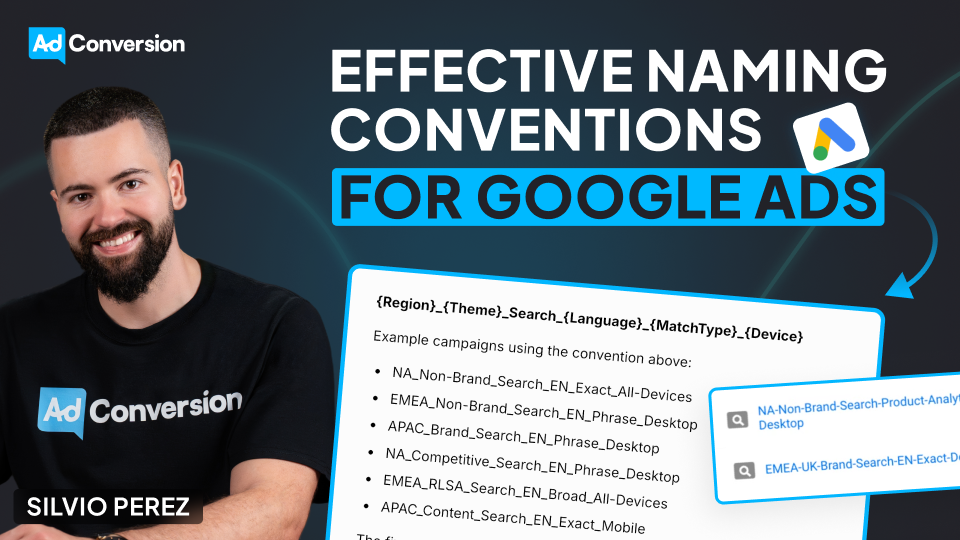
How to Create an Effective Naming Convention for Your Google Ads Campaigns
One of the most overlooked but crucial aspects of running a successful Google Ads campaign is our naming conventions.
I’ve worked with countless clients optimizing their ad performance, and I can tell you that this is the one thing that makes everything easier — or breaks everything.
Why Naming Conventions Matter
A naming convention is the process I follow repeatedly when naming my campaigns.
And from my experience, having a consistent and logical naming convention is essential for my organization and productivity when managing them.
A messy campaign structure makes performance tracking, reporting, and optimization significantly harder.
I feel like trying to find something in a cluttered room — wasting my time and effort. And it can be even worse.
Think about this like sharing a room with a messy roommate. If everything is disorganized, I’ll struggle to find what I need, and so will anyone else trying to help me. But if everything has a place, everything is easier to manage.
A strong naming convention ensures that I, my team, and my tools can quickly understand and filter campaigns without unnecessary frustration.
How to Structure a Naming Convention
Here’s my recommendation to create a naming convention that makes everything easier, based on tests on my campaigns:
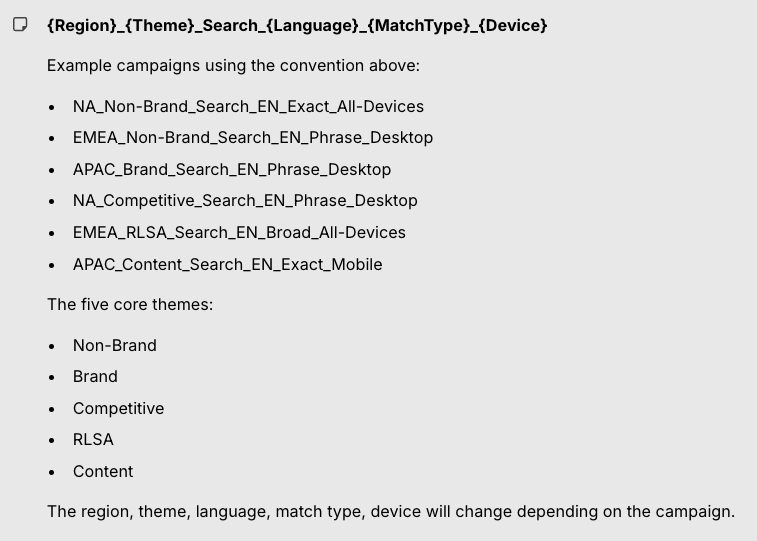
- Region: Where the campaign is being targeted. For example, NA for North America, or EMEA for Europe, the Middle East, and Africa.
- Campaign Theme: The general type of campaign. The five core themes are: Brand, Non-Brand, Competitive, RLSA, and Content.
- Search Type: Identifies that this is a search campaign.
- Language: The language of the campaign (EN for English, ES for Spanish, for example).
- Match Type: The type of keyword match being used: Exact, Phrase, Broad, etc.
- Device: The primary device targeting, generally All Devices, Desktop, or Mobile.
This structure allows us to quickly filter and analyze data in Excel, Google Ads, or any reporting tool.
Examples of Naming Conventions
I came up with some examples of how to apply naming conventions to your campaigns:
A campaign targeting North America, focused on non-brand searches in English, using exact match keywords, and targeting all devices would be named: NA_NonBrand_Search_EN_Exact_AllDevices
A campaign targeting Europe, the Middle East, and Africa, focused on content searches in English, using phrase match keywords, and targeting only mobile would be named: EMEA_Content_Search_EN_Phrase_Mobile
A campaign that targets the Asia-Pacific region, focused on brand searches in English, using phrase match keywords, targeting desktops would be named: APAC_Brand_Search_EN_Phrase_Desktop
A campaign targeting North America, focused on competitive searches in English, using phrase match keywords, targeting desktops would be named: NA_Competitive_Search_EN_Phrase_Desktop
And finally, a campaign targeting Europe, the Middle East, and Africa, focused on RLSA searches in English, using broad match keywords, targeting all devices would be named: EMEA_RLSA_Search_EN_Broad_All-Devices
Benefits of a Good Naming Convention
A well-structured naming convention helps in three major ways:
- Better Performance Tracking: With a clear naming structure, I can instantly see how different segments of my campaigns are performing. No need to dig into settings — everything is in the campaign name itself. This makes it much easier to analyze trends and optimize based on what’s working.
- Efficient Team Collaboration: If multiple people are working on the account, a consistent naming convention ensures everyone understands what each campaign is for. When a new team member joins, they won’t have to waste hours figuring out the structure.
- Faster Reporting & Filtering: When I export campaign data, a structured naming convention lets me quickly filter and sort campaigns based on region, keyword type, device, and more. This makes reporting significantly more efficient.
Should we name our campaigns the same across platforms?
Absolutely!
Naming our campaigns the same across all platforms helps us maintain consistency, simplify analysis, and easily compare performance across different channels when reporting on your overall campaign results.
Please notice that slight platform-specific details might need to be added to the campaign name to account for unique targeting options or features on each platform, but as a whole, having consistent names allows us to easily group data and compare results without confusion.
To sum up
A good naming convention costs you nothing — but the benefits are enormous.
Get it right, and you’ll make everything in your Google Ads campaigns easier to manage, optimize, and scale.
So don’t wait. Go set up your naming convention and start running smarter campaigns!
And if you really want to level up your B2B advertising game, there’s more to master than just negative keywords.
That’s where Google Ads course by AdConversion comes in.
Join 5000+ B2B marketers who are sharpening their paid media skills inside AdConversion’s free, on-demand courses.
Here’s why you should sign up:
✅ 100% free access – No hidden fees, no fluff.
✅ Taught by vetted industry experts – Learn from people who run high-budget B2B campaigns.
✅ Workbooks, resources & templates – So you can implement, not just watch.
✅ Bite-sized lessons (<10 min each) – Easy to fit into your schedule.
Click here to join in under 90 seconds (seriously, we timed it 😂)
How to Track Form Submissions in Google Tag Manager?

I’ve spent a lot of time wrestling with tracking form submissions in Google Tag Manager (GTM), and I know how frustrating it can be when things just don’t work as expected.
Forms behave in all sorts of unpredictable ways. Some refresh the page, some stay put, and others redirect users to a "Thank You" page.
And because there’s no universal rule for how developers build forms, you and I need different tracking approaches depending on the situation.
And since chances are you’re using form submission to also track how your Google ad campaigns are converting, it becomes super critical for us to get this right.
That’s why in this guide, I’ll break down the most effective ways to track form submissions, step by step, so you don’t have to figure it all out the hard way like I did.
Understanding the Tag and Trigger Relationship in GTM
Before we dive into the methods, let’s quickly cover the basics. GTM relies on two key components:
- Tags: These send data to platforms like Google Analytics 4 (GA4).
- Triggers: These tell GTM when to fire a tag.
To track form submissions properly, you need:
- A GA4 event tag that sends a form submission event to GA4.
- A trigger that detects when a form is successfully submitted.
Step-by-Step: Creating a GA4 Event Tag
- Go to Tags in GTM and click New.
- In Tag Configuration, select Google Analytics: GA4 Event.
- In the Measurement ID field, insert your GA4 tracking ID (or use a Constant Variable if you’ve set one up).
- In the Event Name field, enter "generate_lead" (this is a recommended GA4 event, but you can change it if needed).
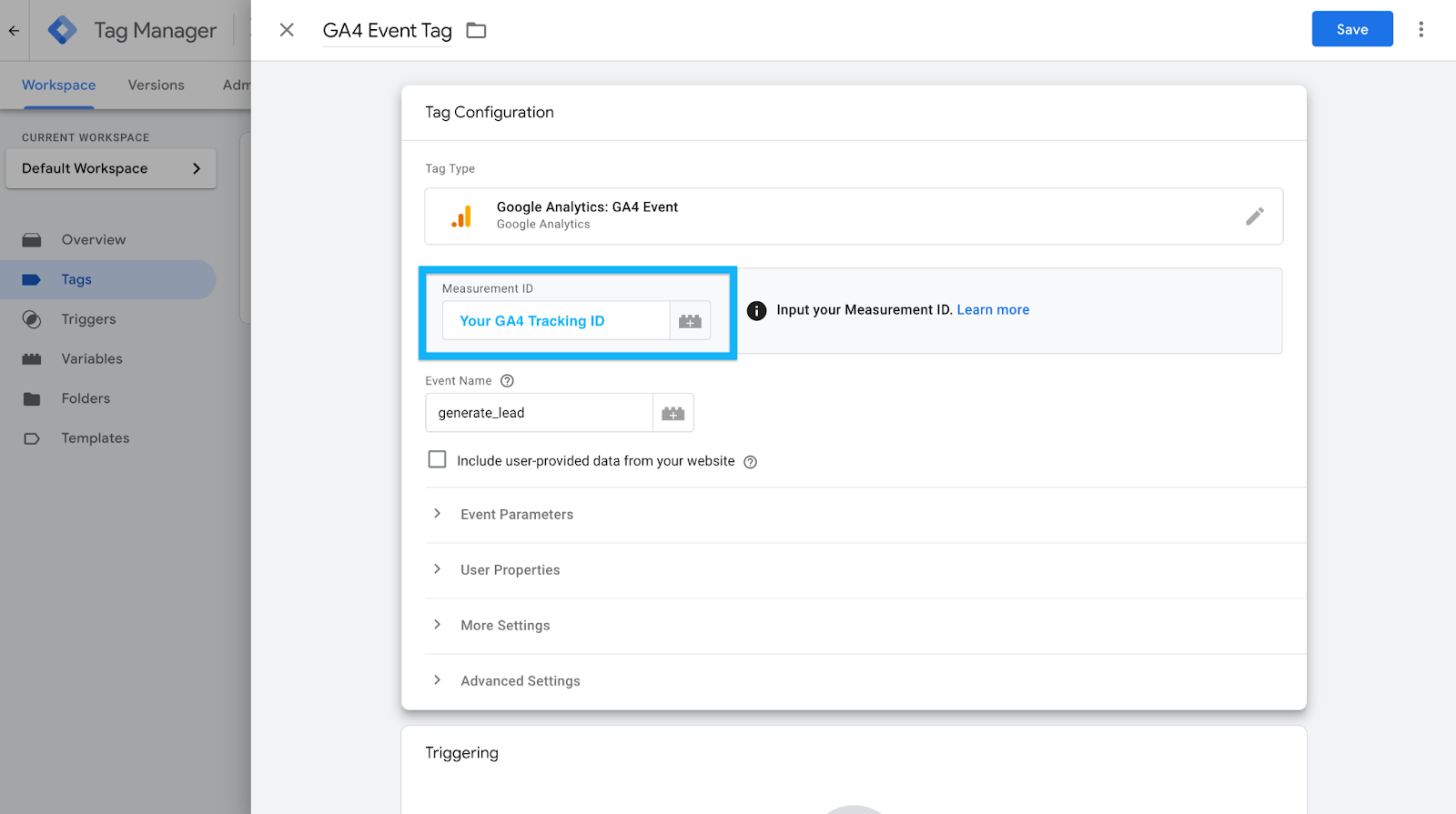
- Leave the Triggering section empty for now. We’ll configure that next.
- Click Save.
At this point, the tag exists but doesn’t do anything because there’s no trigger.
Now, let’s set that up based on how your form behaves.
Method 1: Track Form Submission Using GTM’s Built-in Form Submission Trigger
In an ideal world, GTM’s built-in Form Submission trigger would work for every form.
But in my experience, it rarely does. This trigger only works if the form fires a native submit event, which many modern forms (especially AJAX-based ones) don’t.
Step-by-Step: Configuring the Form Submission Trigger
- In GTM, go to Variables > Configure and enable all Form Variables (Form ID, Form Classes, Form Target, Form Text, etc.).
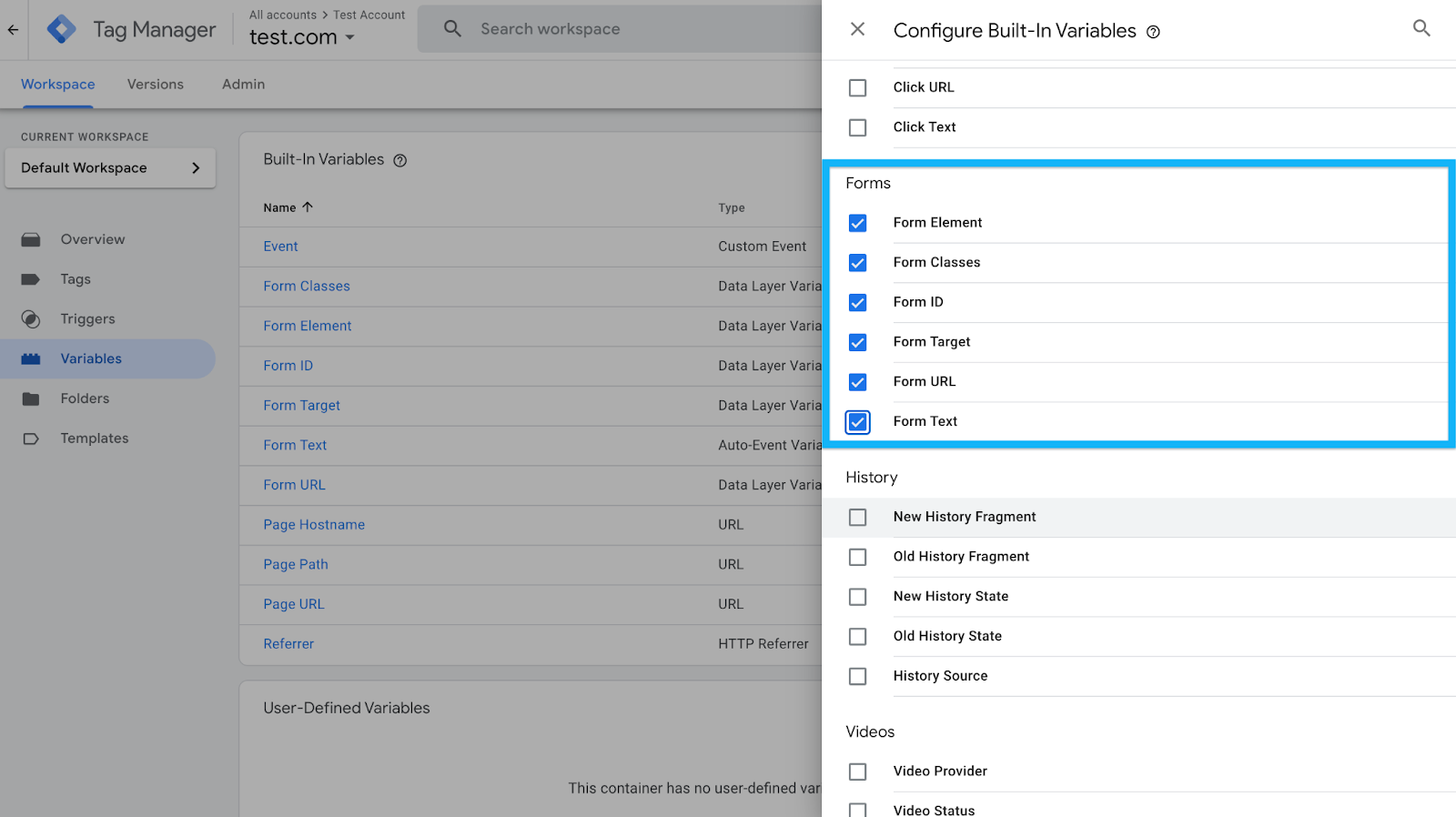
- Navigate to Triggers and create a new trigger:
- Choose Form Submission as the trigger type.
- Choose Form Submission as the trigger type.

- Check Wait for Tags and set a delay (e.g., 2000 milliseconds) to ensure tracking before the page redirects.
- Enable Check Validation to ensure only valid submissions are tracked.
- Under "Enable this trigger on…", set Page Path contains / so it works across the site.
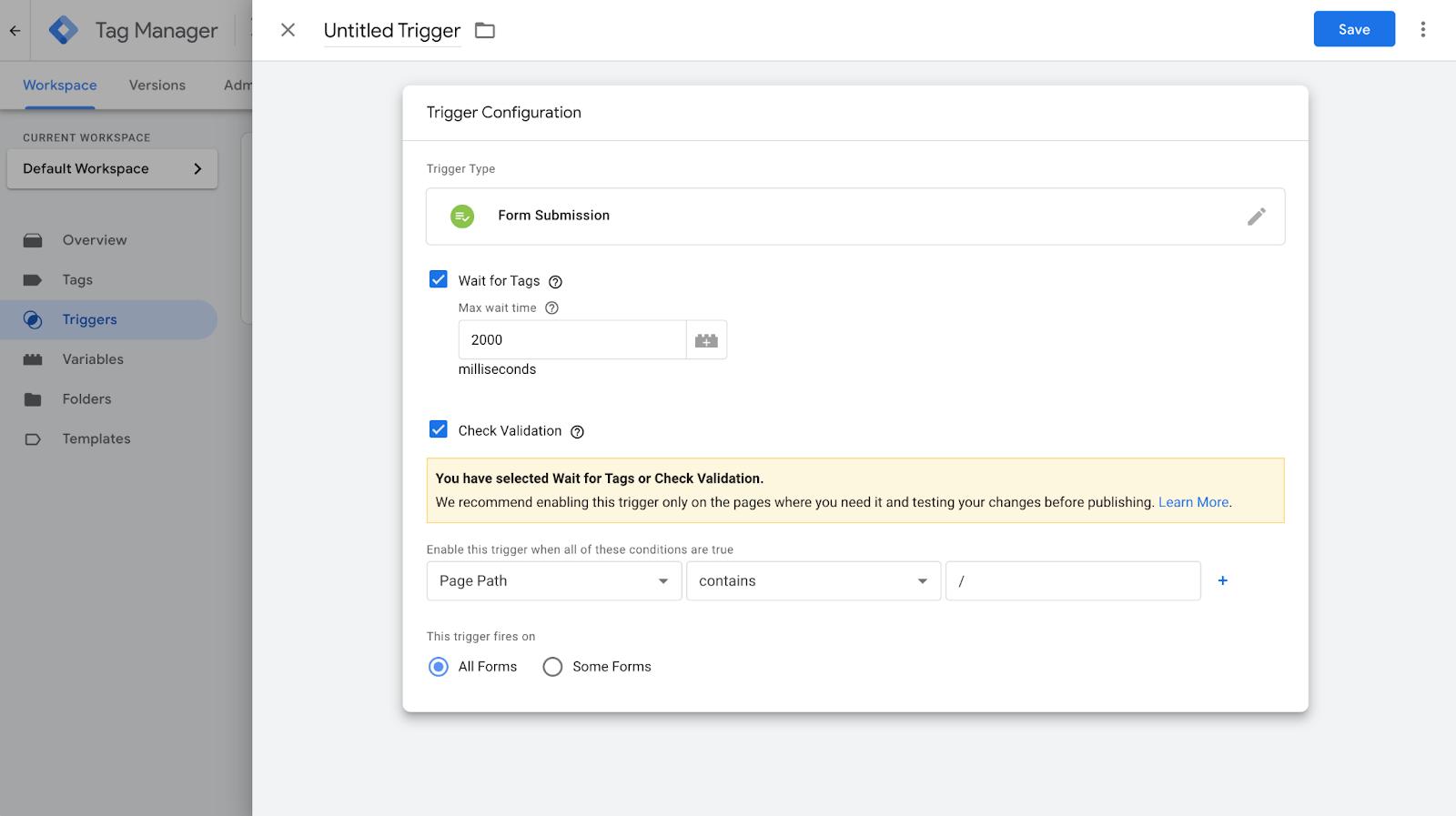
- Click Save.
Assigning the Trigger to the GA4 Event Tag
- Open the GA4 event tag.
- In the Triggering section, select the Form Submission trigger you just created.
- Click Save.
- Enable Preview Mode in GTM and test it by submitting a form.
- Check the GTM Debug Panel to see if a Form Submit event appears.
- If it appears, great! The trigger works.
- If it doesn’t, your form likely prevents the submit event. Move on to the next method.
- If it appears, great! The trigger works.
Method 2: Track Form Submissions via a "Thank You" Page
If your form redirects users to a confirmation page after submission, this is the easiest and most reliable tracking method.
The one mistake I see folks repeat often is they link to this thank you or add it in your sitemap.
The way this method works is it sends an event every time this page is loaded.
So you want to double check to ensure that people don’t land on this page through other sources.
Step-by-Step: Setting Up a Thank You Page Trigger
- In GTM, go to Triggers and create a new trigger.
- Choose Page View as the trigger type.
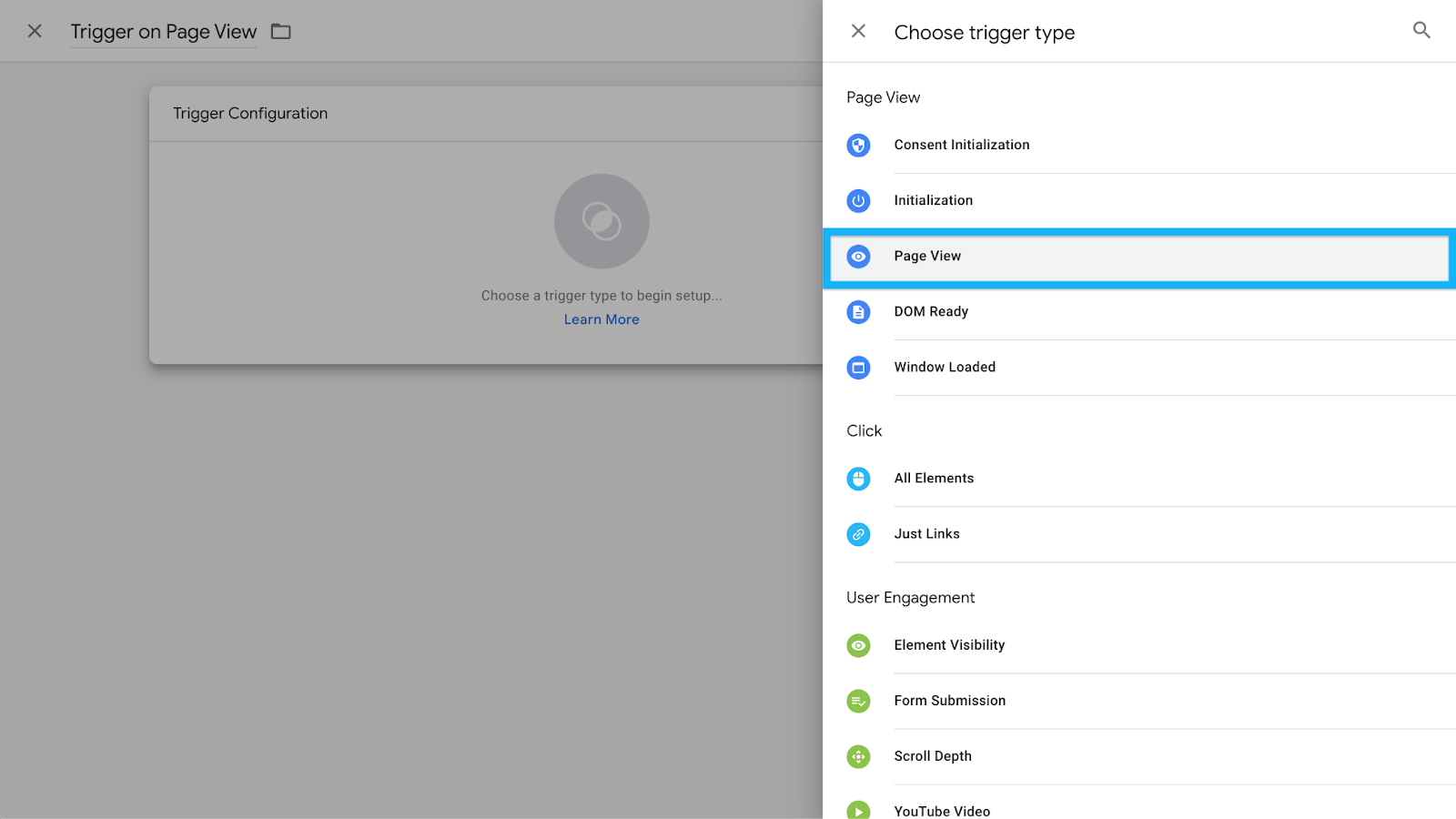
- Select Some Page Views and define the condition:
- If the URL is static (e.g., https://www.example.com/thank-you), set Page Path equals /thank-you.
- If the URL is dynamic, use Page URL contains thank-you (just make sure it’s unique).
- If the URL is static (e.g., https://www.example.com/thank-you), set Page Path equals /thank-you.
- Name the trigger something clear (e.g., "Pageview – Form Submission").
- Click Save.
Assigning the Trigger to the GA4 Event Tag
- Open the GA4 event tag.
- In the Triggering section, select the Thank You Page trigger.
- Click Save.
- Enable Preview Mode and test by submitting the form.
- Verify in GA4 Debug View that the event fires only when users reach the confirmation page.
This method is foolproof as long as users can’t access the "Thank You" page without actually submitting the form.
Enhancing Tracking with Custom Parameters
If you have multiple forms on your website, tracking just a generic "form submission" event isn’t enough.
You need to capture more details that help differentiate between each form submission, such as:
- Form ID: A unique identifier assigned to each form, which can be extracted using GTM’s built-in variables.
- Form Name: Some forms may not have an explicit ID, but they may have a specific name attribute that can be tracked.
- Page URL: If each form is located on a unique page (e.g., /contact-us vs. /signup), capturing the URL will help differentiate where the submission occurred.
- Form Type: If you have multiple lead capture forms (e.g., demo request, newsletter signup, contact form), you can categorize submissions based on the form's purpose.
Step-by-Step: Adding Custom Parameters to the GA4 Event Tag
- Enable Form Variables: Go to Variables > Configure, and enable all Form Variables (Form ID, Form Classes, Form Target, Form Text, etc.).
- Modify Your GA4 Event Tag:
- Open your GA4 event tag in GTM.
- In the Event Parameters section, click Add Row.
- Define custom parameters for form tracking:
- Parameter Name: form_id → Value: {{Form ID}}
- Parameter Name: form_name → Value: {{Form Name}}
- Parameter Name: page_path → Value: {{Page Path}}
- Parameter Name: form_id → Value: {{Form ID}}
- Open your GA4 event tag in GTM.
- Save and Test:
- Enable Preview Mode in GTM.
- Submit different forms on your site and check if the correct form details appear in the GTM Debug Panel.
- If the values are being captured correctly, publish the changes.
- Enable Preview Mode in GTM.
If you want to use this data in GA4 reports, you’ll need to register it as a Custom Dimension:
- In GA4, go to Admin > Custom Definitions.
- Click Create Custom Dimension.
- Define each parameter:
- Name: Form ID → Event Parameter: form_id → Scope: Event
- Name: Form Name → Event Parameter: form_name → Scope: Event
- Name: Page Path → Event Parameter: page_path → Scope: Event
- Name: Form ID → Event Parameter: form_id → Scope: Event

- Click Save.
By implementing this setup, you ensure that every form submission is attributed to the right form, providing clearer insights into form performance, lead quality, and conversion attribution.
PRO TIP 💡
Form submission is just one step in the buyer’s journey.
To truly track and optimize for conversions, map the entire journey. Start from initial engagement to the final revenue event, and track each step.
By tracking and feeding all these data points back into ad networks, you help the algorithm prioritize high-intent users.
Here’s an example of how the buyer journey might look like:
Sales-led Company:

Product-led Company:

We covered how to set it up in detail in this free Google Ads course, which also walks you through full-funnel tracking and measurement strategies.
Conclusion
The right tracking method depends on how your form behaves:
- Use the Form Submission trigger if GTM’s listener detects the event.
- Use the Thank You page method if the form redirects after submission.
- Use click tracking for AJAX-based forms.
Test everything thoroughly in Preview Mode to ensure you’re capturing data correctly.
I’ve been through enough form tracking struggles to know that what works on one site may completely fail on another.
Hopefully, this guide saves you a lot of time and frustration!
If you’re looking to see what the paid media marketing pros are up to, you should come and hang with them in the community.
The community is where you can ask the questions you wouldn’t post on LinkedIn and get insights that you wouldn’t find on Google.
You get access to:
- Weekly experiments with real data: No guesswork, just tested strategies from real campaigns.
- Templates & playbooks: Proven frameworks to streamline our processes and improve efficiency.
- Masterminds & expert discussions: Stay ahead of strategies, tactics, and ad platform changes instead of reacting late.
- Benchmarking against top B2B advertisers: Learn what’s working for others running high-budget campaigns.
Come, sign up and see what the pros are talking about in the community. It takes less than a minute to sign up.
10 Tips for Running ABM and LinkedIn Ads That Actually Work
.jpeg)
I see a lot of companies completely overcomplicate ABM on LinkedIn.
Some think they need an expensive ABM platform just to get started. Others assume that simply uploading an account list and running ads will magically drive pipeline.
Neither approach works.
I’ve tested LinkedIn Ads for ABM across different industries, budgets, and company sizes, and I’ve seen what actually moves the needle. The key isn’t just running ads. It's getting the fundamentals right and making sure ads, targeting, and sales outreach all work together.
In this post, I’m breaking down 10 practical, no-BS strategies I use to make ABM campaigns on LinkedIn drive real results. If you’re tired of wasted budget and low engagement, this is for you.
TABLE OF CONTENTS
- Tip 1: Your Account List is the Foundation. Get It Right
- Tip 2: Upload a Company List, Not a Contact List
- Tip 3: Monitor and Manage Ad Frequency
- Tip 4: Cap Impressions Using LinkedIn’s Company Feature
- Tip 5: Test One-to-One ABM Ads (But Avoid Germany)
- Tip 6: Use LinkedIn Ad Engagement as a Sales Trigger
- Tip 7: Split Campaigns by Employee Size
- Tip 8: Create ABM-Specific Remarketing Lists
- Tip 9: Don’t Sleep on Exclusions
- Tip 10: LinkedIn Ads Are Just One Part of ABM
Tip 1: Your Account List is the Foundation. Get It Right
The account list is the backbone of any ABM campaign.
If your account list is wrong, everything else will fail. Your targeting, your engagement, your pipeline.
A lot of companies just pull a list from a data provider using filters like industry, employee size, and technology stack and assume it’s good to go. But here’s the issue:
- Data providers are never 100% accurate. I’ve used ten different data providers, and they all have their problems.
- You’ll end up with bad data. You might export 5,000 accounts, but not all of them are actually relevant.
How to Build a Better Account List
- Work with sales. Most companies create their ABM list in a vacuum and don’t loop in sales. That’s a mistake.
- Look at past closed-won deals. If you’re just pulling a list of the biggest logos you can think of (Nike, Google, Microsoft) you’re probably missing accounts that actually convert.
- Check the late-stage pipeline. What do these accounts have in common?
- Ensure coverage. What accounts are missing? Just because a sales rep Slack-ed over a few high-profile accounts doesn’t mean they’re the only accounts worth targeting.
A well-built account list makes every impression valuable. If your impression itself isn’t worth anything, your list is wrong.
Tip 2: Upload a Company List, Not a Contact List
Once you have a strong account list, the next step is uploading it to LinkedIn Ads.
This is where a lot of folks make a critical mistake. They upload a contact list instead of a company list.
Why Contact Lists Are a Bad Idea
- Low match rates: You’ll be lucky to get 30-70% of your contacts matched in LinkedIn.
- People change jobs constantly: Your contact list gets stale fast. People get promoted, leave, or switch roles.
- You’ll miss key decision-makers: If someone new joins a company in the target role, they won’t be in your contact list.
Why Company Lists Work Better
- Match rates are 95-100%: LinkedIn recognizes companies better than individual contacts.
- Dynamic audience updates: If someone gets promoted or a new decision-maker joins the company, they’ll automatically be included.
- More precise targeting: You can layer on job titles, seniority, and functions to ensure you’re reaching the right people within those accounts.
If you only upload a contact list, you’ll have to constantly update it. That’s an operational nightmare.
If you upload a company list and use job title filters, LinkedIn does the updating for you. Plus, you get better match rates.
Tip 3: Monitor and Manage Ad Frequency
Since ABM campaigns target smaller audiences, ad frequency can get out of control fast if you’re not careful.
If people see the same ad 40 times in a month, they won’t just ignore you, they’ll actively resent your brand.
I always check my frequency metrics and aim for around three impressions per week per person.
If my frequency goes beyond that, I rotate in new creatives.
How to Manage Frequency
- If an ad is performing well, keep it running until engagement drops.
- If performance starts declining, pause it and swap in a new version.
- Small tweaks work. You don’t need an entirely new creative. Sometimes just changing the headline, background color, or image is enough to reset engagement.
A good ABM strategy requires constant creative refreshes.
If you don’t monitor frequency, you’re going to annoy your target accounts instead of influencing them.
Tip 4: Cap Impressions Using LinkedIn’s Company Feature
One of the biggest budget-wasters in LinkedIn ABM campaigns is uneven ad distribution.
Let’s say you’re targeting 500 companies. If Amazon is on that list, Amazon employees alone might eat up 50% of your budget. Why? Because Amazon has more employees in your target roles than smaller companies.
How to Fix This
LinkedIn has a Company Engagement Feature that lets you cap impressions per company.
- Create dynamic exclusion lists for companies that have received 500+ impressions in the past 7 days.
- Once a company hits that limit, it gets automatically excluded, forcing LinkedIn to spread the budget to other accounts.
How to Adjust Your Cap
- If none of the companies hit the cap → Lower the threshold (e.g., 300 impressions).
- If too many companies are excluded → Raise the cap (e.g., 700 impressions).
This simple tweak ensures that no single company dominates your budget, and every account on your list gets a fair share of impressions.
Tip 5: Test One-to-One ABM Ads (But Avoid Germany)
I’ve been testing one-to-one ABM ads for a while now, and the results have been insane.
A standard LinkedIn image ad usually gets a 0.5% to 1% click-through rate.
But when I run personalized one-to-one ABM ads, I’m seeing 5% - 10% CTRs.
How to Run One-to-One ABM Ads
- Create a simple template.
- Dynamically insert the company name or logo.
- Tweak the messaging slightly to make it feel personal.
These ads stand out because they look like they were designed specifically for the company.
But before you go all-in, there are two major caveats:
- Don’t run these in Germany: German companies will hit you with a legal notice if you use their name or logo in an ad.
- This works best for MarTech, SalesTech, and Customer Success industries: If you’re targeting IT buyers, this approach might feel too aggressive.
If you’re hesitant to use logos, you can still personalize these ads by:
- Mentioning the company in the ad copy instead of the image.
- Using a screenshot from the company’s website instead of their logo.
One-to-one ABM ads aren’t for every industry, but in the right space, they massively outperform standard image ads.
Tip 6: Use LinkedIn Ad Engagement as a Sales Trigger
A big mistake I see in ABM campaigns is running LinkedIn ads in isolation and expecting them to create pipeline on their own.
That’s not how it works.
You need to use LinkedIn ad engagement as a sales trigger to prioritize outreach.
Instead of sales reaching out cold, why not time it based on actual engagement? If an account is consistently clicking on ads or engaging with content, that’s a strong signal that they might be open to a conversation.
LinkedIn lets you create dynamic audience lists based on engagement, which means I can track things like:
- Paid clicks: Who has clicked on an ad multiple times over a set period?
- Video views: Who has watched a certain percentage of a video ad?
- Impressions: Which accounts have received a high volume of impressions?
I can then send this data to sales as a prioritized list of accounts.
A sales rep reaching out to an account that has clicked on an ad three times in the past two weeks is going to have way more success than reaching out completely cold.
Some companies use tools like Fibbler to track progression of clicks over a period of month, all the way towards becoming an opportunity.
But even if you’re just using LinkedIn’s native company engagement feature, you can still set up alerts for sales when an account’s activity spikes.
This is one of the easiest ways to align marketing and sales, yet most companies don’t do it. If you’re just running LinkedIn ads without tying them into your outbound strategy, you’re leaving money on the table.
Tip 7: Split Campaigns by Employee Size
A CEO at a 50-person company is very different from a VP at a 10,000-person company.
You can’t treat them the same.
The way LinkedIn distributes ad spend also makes this even more important. If you mix small and large companies in the same campaign, the large companies will dominate your spend.
Why? Because they have more employees that fit your targeting criteria.
I split campaigns into two groups:
- 500+ employees: Exclude managers. There are too many, and they don’t always have decision-making power.
- Under 500 employees: Keep managers in. At smaller companies, managers have more influence over decisions and often report directly to the CEO.

At big companies, targeting managers is usually a waste of money.
If I’m running an ad campaign for a marketing software company, the CMO at Amazon isn’t going to care about my ad.
But at a 200-person company, the CEO or VP of Marketing might be the final decision-maker.
This segmentation also allows me to write better ad copy. If I know I’m speaking to executives at smaller companies, my messaging will be more direct and high-level.
If I’m speaking to senior managers at larger companies, I might focus more on how my product solves day-to-day problems.
If you’re running a single campaign for all employee sizes, chances are your budget is being wasted on the wrong people at big companies while ignoring the right people at smaller ones.
Tip 8: Create ABM-Specific Remarketing Lists
Most people run generic remarketing campaigns, but for ABM, you need to build remarketing lists specific to your target accounts.
This means you’re not just retargeting anyone who clicked on an ad. You’re only retargeting people from your ABM account list who showed engagement.
Here’s how I structure my ABM remarketing lists:
- Image ad remarketing: People from ABM accounts who clicked on an image ad.
- Video view remarketing: People from ABM accounts who watched at least 50% of a video ad.
- Website remarketing: Visitors from ABM accounts who landed on key pages (e.g., demo request, pricing, case studies).
This ensures I’m spending remarketing dollars on accounts that actually matter rather than random people who engaged once and never came back.
What should you show in these remarketing campaigns?
In remarketing, I shift the content to focus on social proof and direct response ads. This could be:
- Case studies featuring similar companies
- Testimonial ads showing a customer’s face and a short quote
- Comparison ads (e.g., "Us vs. Them")
- Before and after ads that show the pain before using my product and the results after
In some cases, I also test demo CTAs and incentives, especially for enterprise deals where a small push (like a free assessment or report) can make a big difference.
If you’re only running top-of-funnel awareness ads and never segmenting high-intent ABM accounts into remarketing, you’re missing a huge opportunity to convert engaged prospects.
Side Note: Check out all the cool ads that Tim Davidson put together over here.
Tip 9: Don’t Sleep on Exclusions
A lot of people think that because they’re targeting an account list, they don’t need to add exclusions.
That’s a mistake.
Even if your account list is perfect, LinkedIn’s targeting isn’t.
Here’s the problem: LinkedIn doesn’t always match job titles and company names correctly. If someone has multiple roles in their profile, LinkedIn might target them under the wrong company.
For example, let’s say someone runs a side business while working full-time at Amazon. LinkedIn might show them your ad under both companies, meaning you’re wasting budget on someone who isn’t actually part of your ABM target.
To fix this, I always:
- Check LinkedIn’s Demographics Report to see which job titles and industries are getting served ads.
- Exclude job functions that don’t matter. If I’m selling to CMOs and VPs of Marketing, I don’t want my ads going to HR or IT.
- Exclude competitors.
Just because you’re running ABM doesn’t mean you can trust LinkedIn to get everything right.
If you’re not actively reviewing exclusions, you’re burning ad dollars.
Tip 10: LinkedIn Ads Are Just One Part of ABM
I need to make this very clear. Running LinkedIn Ads alone is not ABM.
ABM is about orchestrating multiple touch points across marketing and sales. If you’re just running ads and waiting, you’re missing the point.
Here’s how I integrate LinkedIn Ads into a full ABM strategy:
- Pick a set of high-priority accounts (start with 50-100).
- Run LinkedIn ads to build awareness.
- Monitor engagement signals (clicks, views, impressions).
- Trigger sales outreach when accounts show activity.
- Use email, cold calls, events, and direct mail to reinforce messaging.
- Retarget engaged accounts with case studies and demo CTAs.
- Track movement through the funnel and adjust the strategy.
One of the best ways to start is by working closely with an enterprise sales rep.
Pick 100 accounts and run a coordinated campaign, where marketing runs ads and sales follows up based on engagement.
If you’re just running LinkedIn Ads and calling it ABM, you’re not doing ABM. You’re just running ads to a list.
Hope you found this article helpful!
If you’re looking to learn more about LinkedIn Ads, check out these free LinkedIn Ads courses, that will teach you how to launch, optimize, and scale LinkedIn Ads campaigns effectively or hire LinkedIn Ads agency services.
And if you have any questions about LinkedIn Ads, feel free to send me a message on LinkedIn.


