


How to Run Google Ads for Cybersecurity [Strategy Guide]

Run high-performing Google ads for cybersecurity companies. Learn keyword strategy, best practices, and how to generate a qualified B2B pipeline.
Google Ads


%20-%20new%20v2.png)
Silvio Perez
Founder @AdConversion
Google ads for cybersecurity help your company show up when buyers search for answers to urgent cybersecurity problems.
They might need help with ransomware, comparing compliance tools, or trying to improve cloud security before something goes wrong.
In other words, paid search gives you the chance to enter the conversation at exactly the right moment.
The opportunity is huge, but so are the challenges. Clicks are expensive, buyers are cautious, and deals can take months to close.
Learn how to make Google advertising work harder for your cybersecurity business with smarter strategies, data-backed optimization tactics, and a revenue-first approach.
What Are the Biggest Google Ads Challenges for Cybersecurity Firms?
The biggest Google Ads challenges for cybersecurity companies stem from trying to reach sales-ready buyers in a crowded, technical, and expensive market.
Expensive cost-per-click (CPC)
Cybersecurity is one of the priciest paid search categories.
GrowthSpree’s 2026 Google Ads report puts the average CPC for this sector at $18, which is far higher than other SaaS industries.
The reason is simple: fierce competition. Keywords tied to cloud security, remote access protection, and malware detection attract aggressive bidding from large providers and fast-growing startups.
When clicks cost that much, every lead should have a real chance of becoming a customer.
Broad and irrelevant search intent
Cybersecurity keywords pull in all kinds of audiences, but most of them aren’t a good fit.
Someone searching for ransomware protection or phishing prevention might be a student researching hackers, a consumer dealing with scams, or an IT team looking for free tools.
If your targeting is too broad, Google search ads start burning budget on clicks that never convert.
Lack of buyer trust
Security buyers are skeptical by default. They’ve seen the same claims about threat detection, compliance, and real-time protection too often to trust the first ad that pops up.
Your B2B Google ads and landing pages need to prove your expertise fast. Otherwise, buyers will move on to another vendor.
Highly technical messaging
Cybersecurity products solve complex problems, but your messaging still needs to be simple.
If your Google advertising is packed with technical jargon, buyers might not connect your product to the problem they need to solve.
Google Ads’ character limits make this even harder, so every word needs to earn its place.
Long sales cycles and complex attribution
Cybersecurity deals rarely close after one click. A buyer might first find you through paid search, return later from social media, and finally book a demo call months later.
By the time revenue shows up in your customer relationship management (CRM) system, standard attribution models lose track of those initial touchpoints. That makes it harder to see the true impact of your B2B SaaS Google ads.
Why Do Google Ads Matter for Cybersecurity Companies?
Google ads matter for cybersecurity firms because they show up exactly when buyers are looking for solutions to security vulnerabilities.
Reason #1: Paid search captures existing demand
B2B SaaS buyers do a lot of online research before they ever talk to sales. They compare options, vendors, and reviews to find the best protection against cybercriminals.
Paid search meets users during that research stage, when they actually need cybersecurity services.
Reason #2: Long sales cycles need constant visibility
Most cybersecurity deals take months to close.
Buyers go back and forth between providers, consult with other stakeholders, and wait for budget approvals.
Google Ads campaigns help your brand stay visible throughout that long sales cycle.
Even if someone doesn’t book a demo after the first website visit, repeated paid search exposure keeps your company top of mind.
Reason #3: Buyers search with high intent
Cybersecurity searches usually happen for a reason.
A person looking up ‘managed detection and response providers’ or ‘cloud security platform pricing’ is much closer to making a decision than someone casually scrolling on social media.
If your Google advertising targets the right keywords, you can immediately hook those sales-ready leads.
How Do You Create a Cybersecurity Google Ads Strategy?
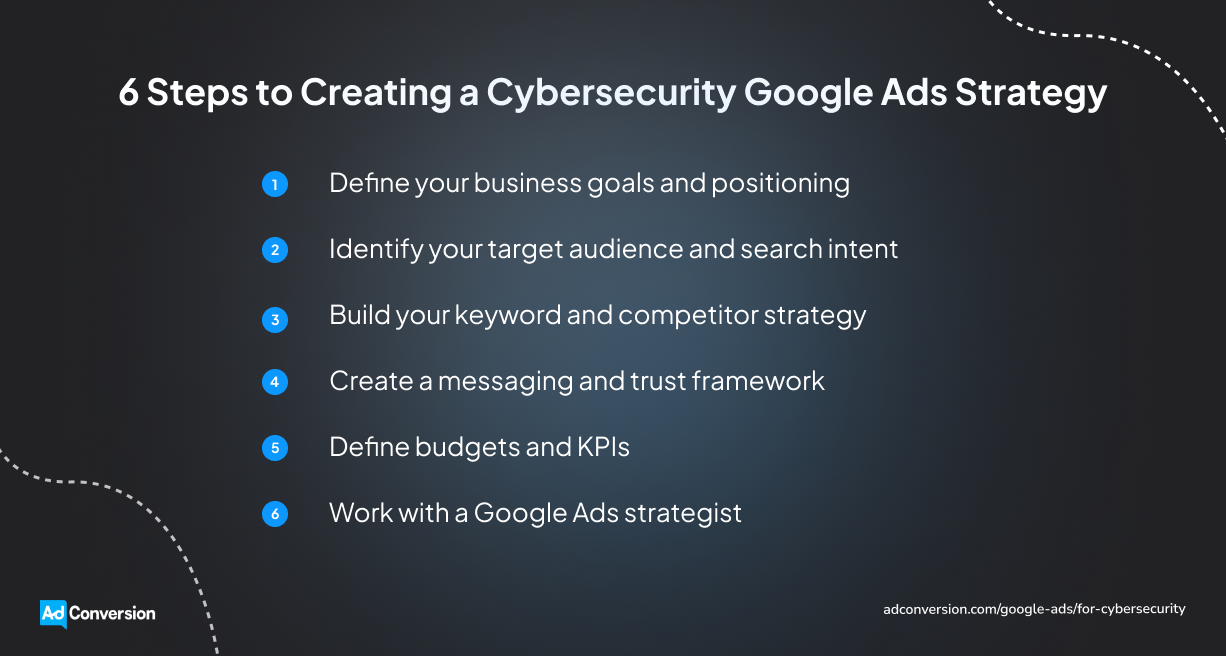
Create a cybersecurity Google Ads strategy by aligning your targeting, messaging, keywords, and ad spend with the buyers most likely to close the deal.
If you’re a beginner, AdConversion’s free online course on how to launch effective Google Ads campaigns is a good starting point.
1. Define your business goals and positioning
Open your CRM and look at the deals you've already won.
Make a list of services that bring in the most revenue and close fastest. That’s where Google Ads can have the biggest impact.
Then figure out why a buyer should choose you.
Most cybersecurity vendors talk about the same things: better protection, faster detection, and stronger compliance. Your job is to find the one thing your company does exceptionally well and build your positioning around it.
That unique trait could be faster incident response, AI data breach detection, or unmatched expertise in a specific industry.
2. Identify your target audience and search intent
Figure out who you're really trying to reach.
Look through recent opportunities and closed deals to spot common job titles, industries, company sizes, and security challenges.
A chief information security officer evaluating cloud security platforms uses very different search terms from an IT manager researching ransomware recovery solutions after a cyberattack.
Once you know who your buyers are, organize keywords by intent.
Keywords, including words like ‘pricing,’ ‘providers,’ ‘software,’ or ‘demos,’ usually point to a buyer getting closer to a decision. Since these searches are most likely to turn into opportunities, they deserve more ad spend.
3. Build your keyword and competitor strategy
List all the cybersecurity services you offer, such as penetration testing, cloud security, VPN monitoring, or compliance consulting. Then build keyword groups around the phrases buyers use when searching for them.
Next, run a Google Ads competitor analysis. Search your highest-value keywords and pay attention to the companies that keep showing up in paid results.
Review their ad copy, landing pages, offers, and calls to action (CTAs). This shows you how competitors position themselves and where you have an opportunity to stand out.
If every vendor is making the same promises, a more specific message can help you grab user attention or fill search gaps.
4. Create a messaging and trust framework
Define the core value proposition you want customers to associate with your brand. For instance, you could deliver better compliance support, 24/7 monitoring, or specialized expertise in cyber threats.
Then gather proof to back up those claims. Certifications, case studies, and client testimonials make great trust signals.
Use these insights to build your messaging. Set clear guidelines for the tone, offers, and CTAs so all your Google Ads campaigns follow the same pattern.
5. Define budgets and KPIs
Figure out where your Google Ads budget can have the biggest impact.
Allocate more ad spend to the services, audiences, and keywords that already contribute to revenue. The rest can go to awareness campaigns, remarketing, and testing new search opportunities.
Next, define how you’ll measure paid search success.
Focus on pipeline, efficiency, and revenue metrics that match your long customer journeys. Sales qualified leads (SQLs), customer acquisition cost (CAC), and return on ad spend (ROAS) are just a few examples.
6. Work with a Google Ads strategist
Creating a cybersecurity Google Ads strategy takes a lot of up-front research and planning. If you don’t get it right, you’ll just waste time and money on campaigns that never pay off.
That’s why many companies prefer to hire Google Ads agencies, like AdConversion, to build their strategy.
AdConversion’s SaaS PPC Agency takes the time to actually understand your business and ICP. Its strategists dig into your positioning, buyer persona, CRM data, and competitors to figure out where your best opportunities come from.
From there, AdConversion builds you a full-funnel Google Ads strategy around your ideal buyer. The team handles everything from creating the messaging framework, campaign narratives, targeting strategy, and keyword direction, so you don’t have to.
How Do You Build Google Ads Campaigns from Scratch?
You can build Google Ads campaigns from scratch by setting up the right campaign structure, targeting, keywords, ads, and landing pages.
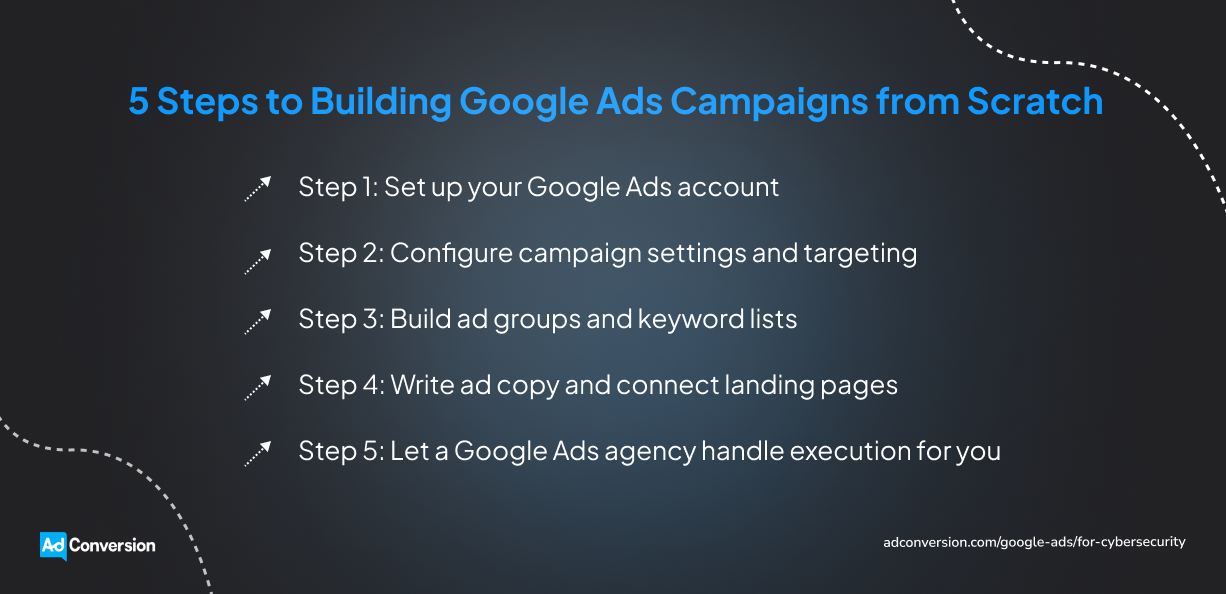
Step 1: Set up your Google Ads account
Create your Google Ads account and configure the basics.
Set your billing information, currency, time zone, and conversion goals right from the start to avoid reporting headaches later.
Then, choose the campaign type that matches your objective:
- Search campaigns put your company in front of buyers the moment they start looking for cybersecurity solutions.
- Display/Remarketing campaigns keep your brand visible while prospects compare vendors, attend demos, and work through internal approvals.
- YouTube campaigns help you build trust and educate buyers on complex security topics long before they're ready to book a call.
As you build your account, keep the structure simple.
Create separate campaigns for different services, industries, locations, or funnel stages. A clean account is much easier to manage, optimize, and scale.
Step 2: Configure campaign settings and targeting
Your campaign settings decide who sees your ads and how Google spends your budget.
Start with geographic targeting. Focus on the countries, regions, or cities your sales team can realistically support. If you only sell to North American companies, there's no reason to pay for clicks from other regions.
Then configure your bidding strategy, language targeting, ad schedule, and devices based on the buyers you’re trying to reach.
This is also the time to set up conversion tracking.
Google Ads and Google Analytics can show you clicks and conversions, but they can't tell which leads become customers. To measure pipeline and revenue, you need to connect Google accounts to your CRM.
Create an effective naming convention for your Google ads and use it consistently in your UTM parameters. This makes attribution much easier once campaigns start generating leads.
To speed things up, you can use AdConversion’s free UTM generator.
Step 3: Build ad groups and keyword lists
Create separate ad groups for each specific problem or solution.
For example, 'SIEM [security information and event management] implementation services,' 'zero trust security solutions,' and 'SOC 2 [system and organization controls] compliance audits' should all have their own ad groups, keywords, and messaging.
Then, build keyword lists based on the phrases buyers type into Google search. You can use a mix of:
- Exact-match keywords, like ‘zero trust security solution,’ ‘vulnerability assessment company,’ ‘incident response services,’ and ‘cyber incident response retainer.’
- Phrase-match keywords, such as ‘third party risk management software,’ ‘managed firewall services,’ and ‘security operations center provider.’
- Long-tail keywords, like ‘cybersecurity consulting for manufacturing companies,’ ‘ransomware recovery services for healthcare organizations,’ and ‘managed security services for multi-location businesses.’
You should also use negative keyword lists to block irrelevant searches and avoid wasting budget.
Step 4: Write ad copy and connect landing pages
Your Google ads should instantly tell buyers they’re in the right place. Write headlines and descriptions that clearly explain what your cybersecurity company does, who it helps, and why it’s trustworthy.
Keep the messaging simple and specific, and include certifications, compliance expertise, and customer proof whenever you can.
AdConversion's three simple steps to writing responsive search ads might come in handy.
Make sure the landing page matches the promise of the ad. If someone clicks an ad about SOC 2 compliance, they should land on a SOC 2 compliance page, not a generic homepage.
Your landing pages should also make it easy for buyers to take the next step.
Include a CTA that clearly communicates what happens after someone clicks. Common examples include: book a demo, schedule a consultation, or request a security assessment.
Keep forms as short as possible. A name, job title, work email, and company name are usually enough to start the conversation. If you add more fields, users will likely abandon the form before submitting it.
Step 5: Let a Google Ads agency handle execution for you
If you don’t have the time or manpower to build campaigns in-house, a Google Ads agency, like AdConversion, can do it for you.
AdConversion’s Cybersecurity SaaS Agency handles the entire creative process internally. The team writes copy for Google search ads, designs display ad visuals, and aligns messaging with your services, ICP, and buying stages.
The agency can also turn your user-generated content into YouTube video ads to expand your reach.
Instead of reusing generic service pages, AdConversion builds high-converting landing pages for each campaign. This means the keyword, offer, and CTA all match the original Google ad the buyer clicked on.
The agency experiments with new ad formats, keywords, offers, and landing page elements all the time to keep campaigns fresh and bring in more sales-ready leads.
AdConversion even won the Paid Advertising Agency of the Year in Cybersecurity Award at Cyber Marketing Conference 2025, so you can rest assured you’re in good hands.
What Are the Best Google Ads Keywords for Cybersecurity?
The best Google Ads keywords for cybersecurity target buyers actively researching security solutions, compliance support, or vendor alternatives.
High-intent commercial keywords
High-intent commercial keywords come from users who already know what type of cybersecurity solution they need. Example keywords include:
- managed detection and response provider
- SOC as a service company
- cloud security platform
- endpoint detection and response software
- malvertising protection services
- malicious content detection software
- penetration testing services
Compliance-focused keywords
Compliance searches convert well because companies need help fast to pass audits or meet security requirements.
- SOC 2 compliance consulting
- ISO [International Organization for Standardization] 27001 cybersecurity consultant
- HIPAA [Health Insurance Portability and Accountability Act] security risk assessment
- PCI DSS [Payment Card Industry Data Security Standard] compliance services
- NIST [National Institute of Standards and Technology] cybersecurity framework consultant
- GDPR [General Data Protection Regulation] security compliance audit
Competitor keywords
Competitor searches involve buyers who understand the market and are comparing vendors before making a decision.
- CrowdStrike alternative
- SentinelOne competitor
- Microsoft Defender for Business alternative
- Arctic Wolf MDR pricing
- Wiz cloud security competitor
- Sophos MDR alternative
Negative keywords to exclude
Negative keywords help filter out irrelevant traffic before it wastes your ad spend. They include:
- free
- course
- certification
- jobs
- internship
- definition
How Do You Optimize Google Ads Campaigns for High-Quality Leads?
Optimize Google Ads campaigns for high-quality leads by making data-driven decisions about targeting, budget allocation, and growth opportunities.
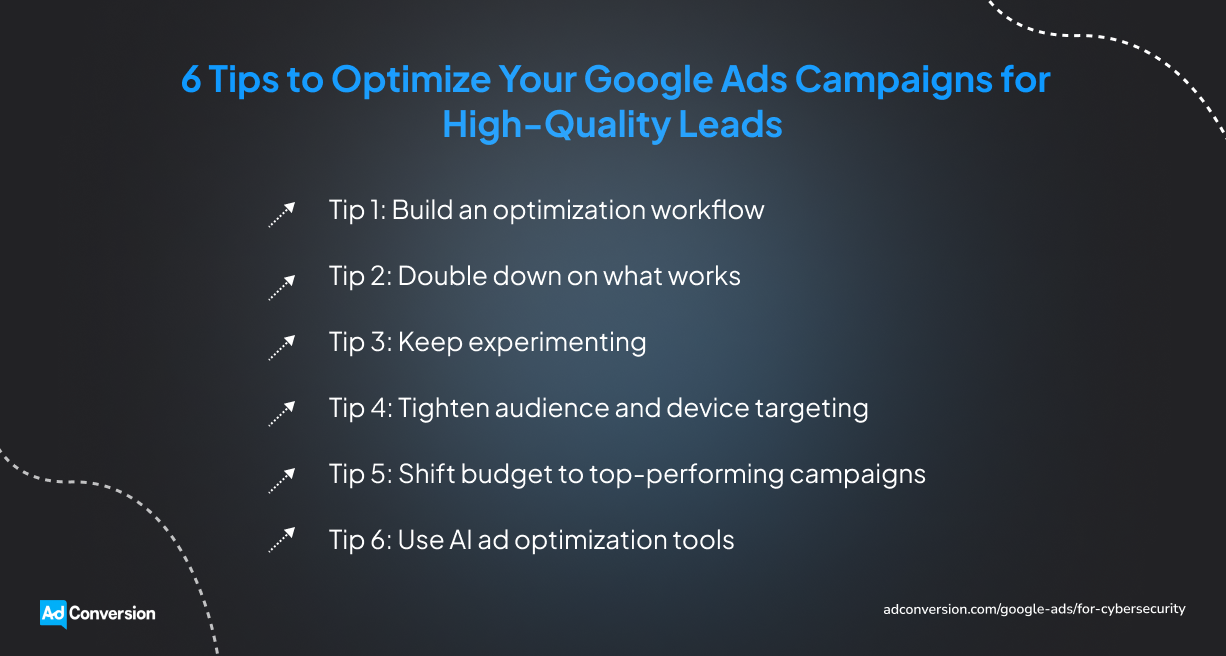
Tip 1: Build an optimization workflow
Cybersecurity Google advertising doesn't fall apart overnight. Performance usually slips little by little as wasted spend, irrelevant searches, and weak conversion rates go unnoticed.
That’s why you need to create a Google Ads optimization workflow and stick to it. Your calendar should include:
- Daily reviews: Check budget pacing, search terms, and bidding performance. The goal is to catch waste before it snowballs, whether that's irrelevant searches, high CPCs, or campaigns that are spending too quickly.
- Weekly reviews: Expand your high-intent and negative keyword lists, pause weak ads, and look for opportunities to improve CTRs and conversion rates. These smaller optimizations help improve lead quality and make better use of your budget.
- Monthly and quarterly reviews: Step back and look at the bigger picture. Audit campaign settings, review landing page performance, and analyze CRM data. Then decide where you should increase, reduce, or reallocate the ad budget.
Tip 2: Double down on what works
Paid search can generate lots of e-book downloads, webinar signups, or form submissions that don’t actually contribute to your revenue.
You need to dig deep into your CRM data to figure out which keywords, ads, and landing pages turn into demo calls, consultations, and sales opportunities.
Once you find what’s working, allocate more budget to it. Scaling proven winners can contribute to revenue growth just as much as chasing new ideas.
Tip 3: Keep experimenting
No Google ad campaign stays effective forever. Buyers change how they search, competitors launch new offers, and messaging that worked six months ago might no longer stand out.
Continuously test new elements to keep campaigns fresh and relevant. Rotate new headlines, try different CTAs, experiment with landing page layouts, and create new offers.
Tip 4: Tighten audience and device targeting
Review paid search performance by location, device, audience segment, and demographic group. Look for patterns that signal wasted spend or poor lead quality.
For example, mobile traffic might get you lots of clicks but very few sales opportunities for enterprise cybersecurity services.
Remove any low-performing segments to improve results without increasing spend.
Tip 5: Shift budget to top-performing campaigns
Don’t spread your ad spend evenly across every campaign. Rank campaigns based on pipeline generated, customer acquisition cost, and revenue contribution.
Then gradually shift more budget toward those top-performing campaigns while reducing spend on weaker ones.
Tip 6: Use AI ad optimization tools
Manual optimization only goes so far when campaigns run 24/7.
AI tools can spot performance drops and take action as they happen, moving much faster than humans.
AdConversion’s AI ad optimization platform, Sami, watches over your Google ads round the clock to reduce wasted spend.
If a keyword’s CPC exceeds your threshold with no conversions to show for it, Sami instantly pauses it and redirects the budget to a top-performing ad.
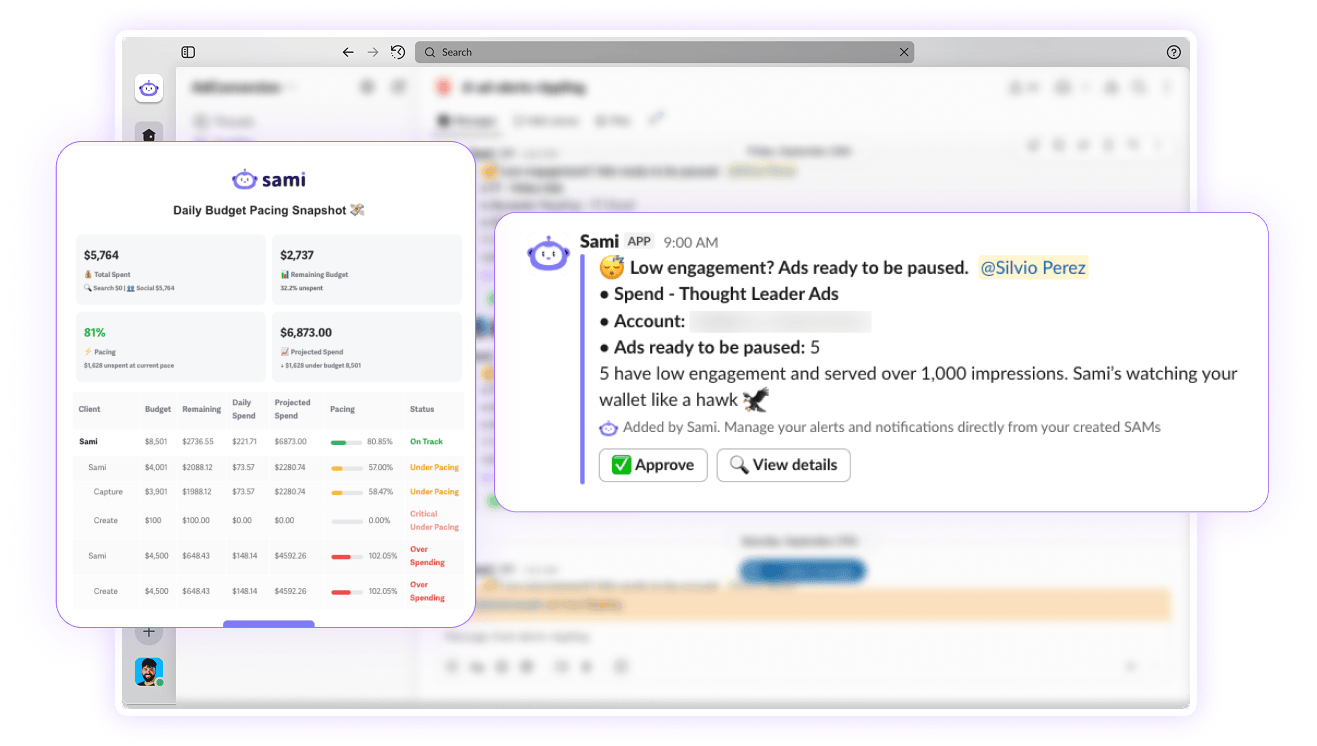
To learn more about campaign optimization, you can check out AdConversion’s free Google Ads course on how to convert clicks into profit.
How Do You Measure ROI for Cybersecurity Google Ads?
Measure the return on investment (ROI) of your cybersecurity Google ads by connecting ad spend to pipeline and revenue, and comparing what you earned to what you invested.
1. Define your total investment
Figure out exactly how much money you’ve invested in Google Ads.
Ad spend tells only part of the story. You also need to account for agency fees, landing page development, ad creatives, tracking tools, and any other related costs.
If you leave those expenses out, your ROI numbers will look much better than they really are.
2. Connect Google Ads to your CRM
You cannot measure ROI if your marketing and sales data live in separate systems.
Connect Google Ads to your CRM to follow every lead beyond the initial conversion. Instead of seeing only form submissions, you can check which campaigns produce SQLs, opportunities, and closed deals.
This visibility is key in cybersecurity, where buyers spend months evaluating providers before signing a contract.
3. Use revenue dashboards
Once data starts flowing between Google Ads and your CRM, you need a simple way to make sense of it.
A revenue dashboard brings campaign performance and sales outcomes together in one view. Instead of manually comparing spreadsheets, you can quickly see how much pipeline and revenue your ads produce.
If building this reporting system sounds like a lot of work, you can let your Google Ads agency handle it.
AdConversion creates custom Paid Revenue Dashboards and links them to your Google Ads and CRM. The dashboard can also connect to LinkedIn, Meta, Reddit, and other paid media accounts to give you a cross-channel view of advertising performance.
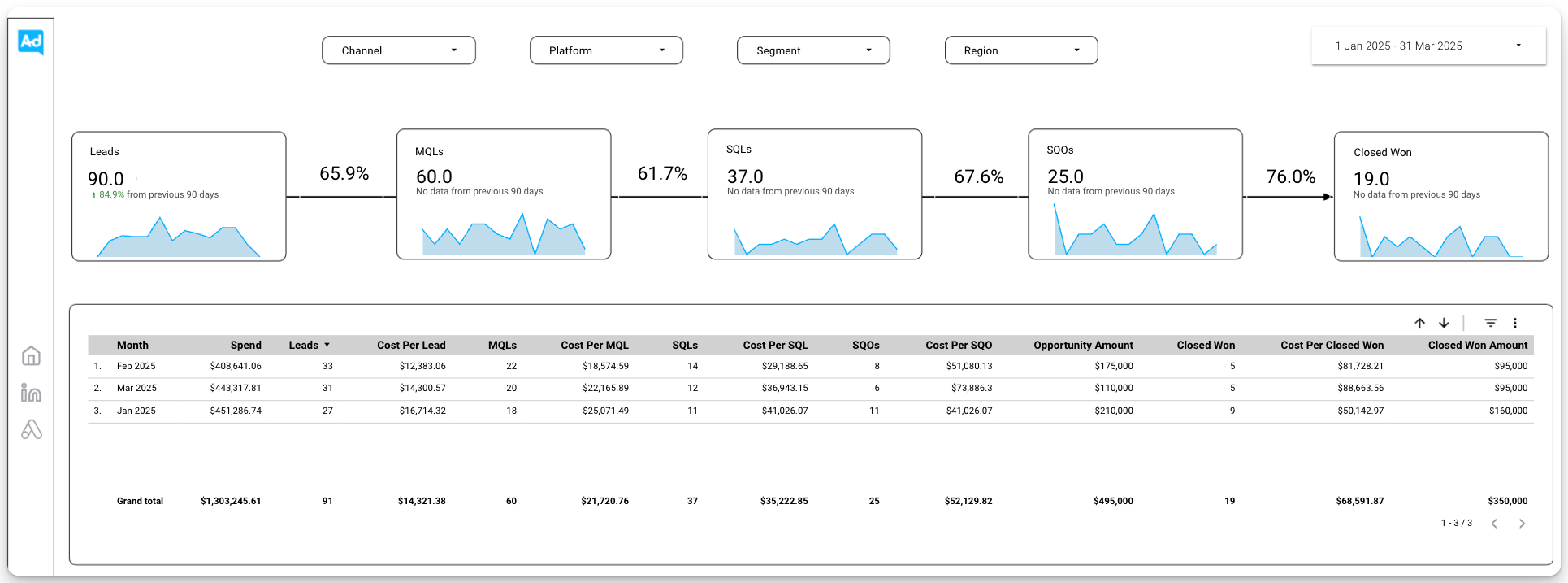
The data updates in real time, so you can check revenue metrics like cost per SQL, ROAS, and closed-won revenue anytime without waiting for manual reports.
4. Do the math using a simple formula
Once you know how much you spent and how much revenue your campaigns generated, you can use this formula to calculate ROI:
ROI = [(Revenue Generated - Total Investment) / Total Investment] × 100
For example, if your Google ads generated $400,000 in revenue and your total investment was $100,000, your ROI is 300%.
Once you’re ready to scale your Google Ads campaigns for higher ROI, you can take AdConversion’s free online course for advanced advertisers.
What Google Ads Mistakes Should Cybersecurity Companies Avoid?
Cybersecurity companies should avoid the following Google Ads mistakes:
- Targeting broad keywords can attract plenty of clicks without bringing in buyers. Before long, your budget gets eaten up by traffic that never turns into pipeline.
- Sending traffic to generic pages makes buyers work too hard to find the information they came for. Most people won't take the time to dig through your website and will simply leave.
- Using last-click attribution gives all the credit to the final touchpoint before conversion. This makes it easy to overlook the Google ad campaigns that helped start the buying journey.
- Optimizing for leads instead of revenue gives you an unrealistic view of performance. What matters is not how many leads you generate, but how many become customers.
- Treating campaigns as ‘set-and-forget’ is one of the fastest ways to lose performance over time. Your campaigns need to keep up with the trends and changing buyer behaviors.
Final Thoughts
The best Google ads for cybersecurity don't succeed because of one great keyword or ad. They succeed because the team behind them keeps refining the strategy, learning from the data, and making small improvements over time.
Cybersecurity paid search is highly competitive, but there’s still plenty of opportunity as long as you stay focused on pipeline and revenue.
If you'd like to compare notes on your current strategy or need help running your campaigns, have a quick chat with AdConversion.

.png)
Related Articles
How to Optimize Google Ads: A Step-by-Step Guide
10 Google Ads Automation Tools to Manage Paid Campaigns
How to Run Google Ads for Cybersecurity [Strategy Guide]
Join 0,000 B2B marketers leveling up their paid advertising skill set! 🚀
Join 0,000 B2B marketers leveling up their paid advertising skill set! 🚀


